
The Enneagram is often approached as a map of nine recurring ways in which attention, desire and self-experience organise themselves through the personality as a protective mechanism. Each Enneagram also points to a Point with an original quality - a possibility present in every human being. In this essay Point Seven takes centre stage: a natural temperament of freedom, perspective, joy in life and expansiveness. As in the other essays, here too I distinguish between the living potential of the point itself - the Pure Gold - and the way the personality narrows this potential into a survival strategy - the Pure Fixation. Within the series on the nine temperaments, we previously covered Eight (Vitality), Nine (Unity), One (Purity), Two (Exchange), Three (Value), Four (Original Identity), Five (Wisdom) and Six (Trust). Here the focus shifts to Seven: as a psychological pattern and as a reminder of a deeper kind of freedom - a freedom that arises from fully inhabiting the present, as opposed to the personality's greedy urge to keep collecting ever more experiences.
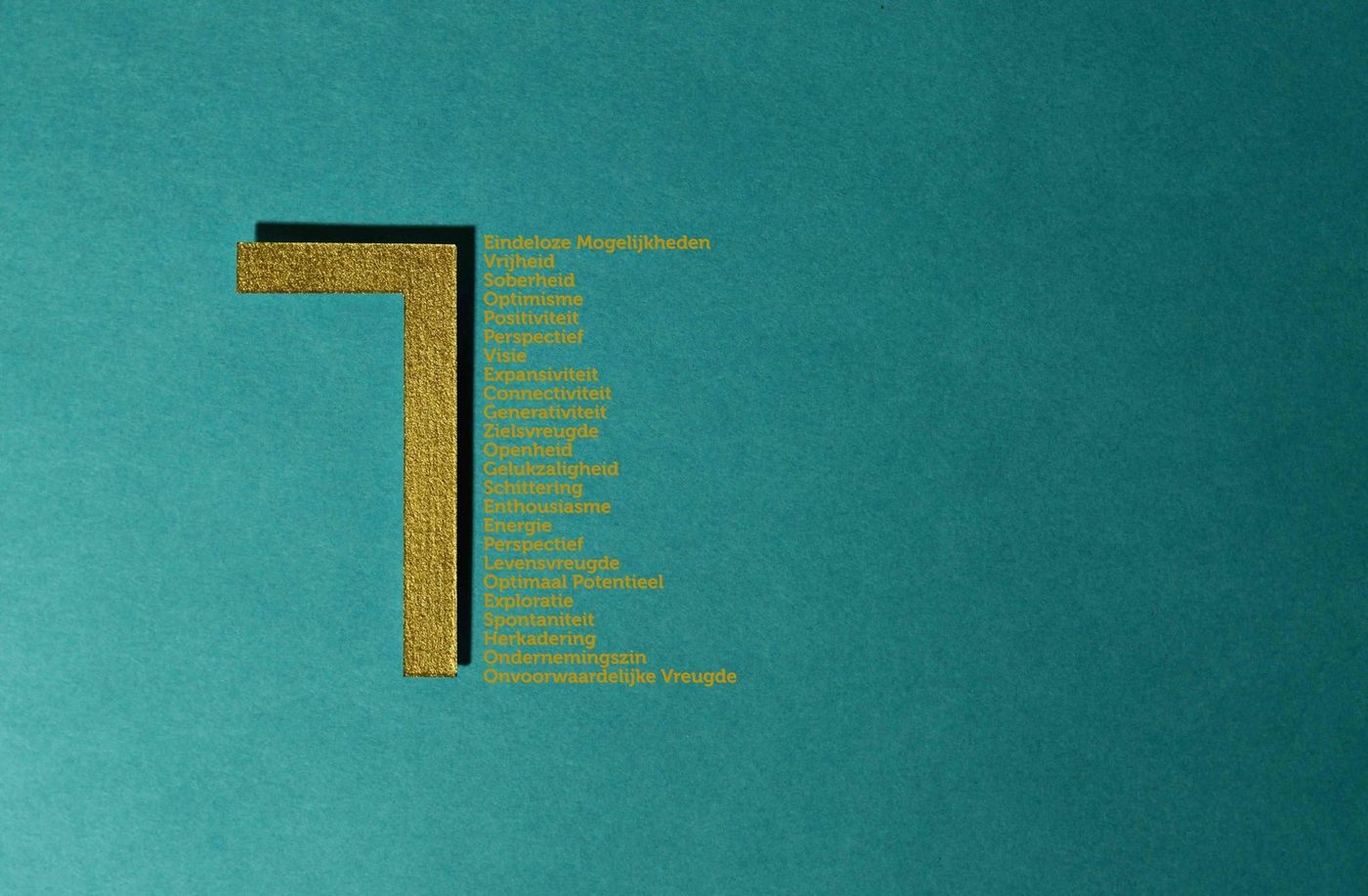
Point Seven touches a primal principle of Possibility, Freedom and Sobriety. I like to describe the Pure Gold of Seven with words such as perspective, vision, expansiveness, connectivity, generativity, unconditional joy, soul joy, openness or enthusiasm, while I define the Virtue of the personality pattern 'Enneagram 7' as 'the experience of the self and the present in the simplicity of the moment'. Set against this is the Vice of gluttony: the excessive desire to keep experiencing more, without limit or depth - visible in terms such as impulsive, restless, superficial, monkey mind, unfocused, unreliable, minimising, escapist and pain-avoiding.
Essence: Freedom and Sobriety as Pure Gold
In the Enneagram tradition, Point Seven is linked to the 'Holy Idea' (a guiding principle or mental concept) of Holy Wisdom, Holy Work and Holy Plan: the insight that reality is not merely a series of separate opportunities, but a living unfolding with coherence, direction and meaning. The Diamond Approach describes this as a way of experiencing in which presence and basic trust show that becoming does not have to be produced by the ego. David Daniels links Seven to an original, concentrated freedom that can travel through the full spectrum of life without having to flee from it. That is a very different freedom from non-committal indecision. It is rather the freedom of attuned participation in endless possibilities.
From that essence, sobriety is not a drab self-restriction. It is simply the experience of 'enough'. It is not about 'wanting less', but about 'being able to carry the full weight of this moment without immediately needing a next one'. In psychological terms this touches an important distinction: positive emotions can only broaden our repertoire of thinking and acting when they do not degenerate into numbing as a denial of the negative. Fredrickson shows that joy, interest and contentment open our attention and build resources. At the same time she emphasises that contentment invites savouring and integration. The healthy strength of Seven, then, is not a permanent enthusiasm, positive stimuli and endless acceleration: it is a lively openness that can also land.
This ties in closely with the words I put forward myself to help us re-member the Seven point: perspective, vision, expansiveness, connectivity, generativity. When Point Seven is expressed in balance, a kind of visionary intelligence emerges: the ability to see possibilities without losing sight of the concrete (Point One). Enthusiasm then becomes, instead of an escape route, a wonderful, creative force. Optimism shifts from denial to an ability to recognise potential. Freedom changes from aversion to limitation into the suppleness to deal creatively with what is. In that sense Seven is akin to what positive psychology calls savouring: truly letting in and deepening the experience of the good.
It is precisely here that it becomes clear why I find it so important to offer gratitude as a counterweight to the longing for more. Research into gratitude and wellbeing shows that a grateful orientation is associated with greater contentment and emotional wellbeing, and also helps to anchor attention in what is already valuable. Emmons and McCullough found that simple gratitude exercises can raise our positive mood and subjective wellbeing. Wood and colleagues, in turn, describe gratitude more broadly as a way of perceiving that makes appreciation possible for the positive that is already present. For Seven that is crucial: gratitude subtly leads the movement from 'something else' back to 'this too'. In this way our personality does not experience a 'lack', which is an instant trigger that fuels gluttony - it even gives a sense of abundance, so that our personality can relax and our nervous system can regulate again.
At the same time, healthy freedom always calls for a refined relationship to exploration. Psychological and biological research into the 'explore/exploit trade-off' shows that life is constantly balancing between exploring and exploiting: between being open to the new and truly being nourished by what has been found. Addicott and colleagues describe this balance as a fundamental decision-making problem in humans and animals. The healthy strength of Seven lies precisely there: in expansiveness without fragmentation. In neuropsychological terms this touches approach motivation and exploration, systems in which dopamine plays a role. And even there the same applies: exploration only has value when it does not come loose from integration. Precisely the growth path for Enneagram 7.
Mirrors in nature and the universe
Hummingbirds - freedom as rhythm, without randomness
At first glance hummingbirds seem perfect Seven creatures: fast, light, darting from flower to flower. Look more closely and you see something else. Research into 'traplining' shows that hummingbirds visit nectar sources in relatively fixed sequences - so not at random. Follow-up research also showed that these routes can take on a temporal regularity too. In other words: their 'freedom' rests on an intelligent combination of movement, memory and timing, not on chaotically hopping here and there. That is a beautiful mirror for the essence of Seven. True freedom does not call for endless variety; it calls for a living rhythm that makes nourishment possible.
Albatrosses - expansion through attunement
Albatrosses, too, embody a form of almost mythical freedom: great distances, open ocean, seemingly boundless movement. Yet their efficiency does not rest on restless muscle work. They use 'dynamic soaring**’**: a refined way of gaining energy from wind shear, which allows them to cover enormous distances without constantly flapping their wings. The freedom of the albatross thus stems from attunement to a larger field that carries them without costing more effort. For Seven that is essential. The deepest expansiveness arises by letting yourself be carried by a greater order and realising that we do not have to be the engine behind everything ourselves.
Starling murmurations - freedom in connectedness
In starlings we see yet another mirror. In flocks of thousands of birds, the coordination between individuals turns out to be topological: each bird aligns with a fixed number of nearby neighbours. As a result the whole stays coherent, even when the density changes. Freedom here moves from separate individuality to a field of connected connectivity. The Pure Gold of Seven is at once individual enthusiasm and the ability to stay lightly, creatively and vividly connected.
Star formation - possibility needs boundaries
The cosmos itself confirms the same principle. Stars arise from unbounded expansion, and also from cold, dense gas clouds that condense under gravity. Possibility only becomes visible as light when matter comes together sufficiently, cools and lets itself be shaped. Richard Larson describes star formation as a process of condensation, collapse and gradual organisation. That is a moving mirror for Seven: infinite possibility only becomes creative when it receives a body, a pace, a form and a boundary. Without gravity no star; without limitation no real incarnation of potential.
Play behaviour in animals - biological joy-intelligence
In behavioural biology, play has long no longer been seen as merely 'excess energy'. In their influential review, Špinka, Newberry and Bekoff describe play as a form of 'training for the unexpected': through play, animals develop flexible motor and emotional responses to sudden events in which they temporarily lose control. Play is therefore not a useless detour alongside real life; it is a practice space in which the organism learns to deal with surprise, instability and the restoration of balance. That makes play particularly relevant as a mirror for Point Seven. Healthy Seven energy is more than excitement; it is the ability to meet novelty without freezing. In play, animals even actively seek out that novelty. They 'self-handicap', voluntarily take on a mild form of disruption, and so practise their freedom of movement within safe frames. The joy of play turns out to be intimately bound up with practising flexibility. We do not want to avoid uncertainty; we want to embody it precisely so that we can learn from it. In nature, playfulness is thus often a serious intelligence of future-orientation: the organism becomes roomier, more mobile and more creative because it is safe enough to experiment.
Serotinous pine cones - hope that works through fire
In the lodgepole pine forests of North America, serotinous cones stay closed for years thanks to a resin bond between their scales. Only when heat melts that resin do the cones open and release their stored seeds. That is ecologically radical: what at first sight destroys simultaneously activates a mechanism of continuation. The forest thus also renews itself by making selective use of a disturbance that looks negative at first sight. The higher pole, or higher side, of Seven is therefore not 'even more fireworks'; it is sobriety: staying present with what is difficult, allowing depth, developing gratitude and finding freedom in simplicity. The lodgepole pine embodies exactly that principle. It does not escape the fire: it uses it within the limits of rhythm, duration and ecological reality. This is, as it were, a 'mature optimism' - hope that does not deny the fire, hope that knows when heat becomes fertile and when delay only brings loss.
Cosmic expansion and the Orion Nebula - generative spaciousness
On a cosmic scale too, a Seven-like principle appears, and again in a surprisingly sober form. In ESA's explanation of the history of cosmic structure formation, it becomes clear that after the early expansion phase and after the release of the cosmic background radiation, ordinary matter became free enough to clump together under the influence of gravity. From initial fluctuations, sheets, filaments and nodes gradually emerged: the cosmic web that later made stars and galaxies possible. Expansion alone is therefore not 'the point'; expansion creates the conditions under which form can arise. That detail is important: it corrects the misconception that more space automatically means more life. Even in the universe, generativity works through a double movement: enough openness is needed, and also enough concentration. ESA describes how the densest nodes in that cosmic web eventually gave rise to the first stars and galaxies. Possibility only becomes creative when energy is allowed to gather somewhere.
The Orion Nebula is a near and tangible image of this. ESA shows the Orion A cloud as a turbulent star-forming region full of gas, dust, pillars and protostars - literally 'the seeds of new stars'. NASA describes Messier 42 as the nearest large star-forming region to Earth, with central Trapezium stars that shape the nebula and with protoplanetary discs around newborn stars. It is a place where expansion and birth stand side by side: the cloud is spacious, chaotic and yet highly productive.
For Point Seven this is perhaps the most cosmic formulation of Pure Gold. Space is not an emptiness to be filled with ever new stimuli. It is a cradle of potential. Healthy expansiveness then means: being so spaciously present that something new can truly arise, and at the same time so grounded that this possibility does not evaporate into abstract fantasies about the future. True freedom leaves possibilities open and also helps them to incarnate. The universe creates by letting light ripen within the cloud, not by pushing the darkness away.
From Essence to personality: when possibility becomes defence
As with every Enneagram pattern, personality arises where essence no longer flows freely. With Seven too, this happens in a very specific way: the original openness to possibility narrows into an inner conviction that pain, limitation and emptiness must be avoided. Official Enneagram descriptions summarise the Seven pattern as optimistic, spontaneous and versatile, and also as overextended, scattered, undisciplined and impulsive when that optimism becomes a defence. The Narrative Enneagram tradition puts it sharply: Enneagram Seven keeps possibilities open to secure a good life, and precisely because of that often also avoids pain and limitation. That brings us to the shadow words mentioned earlier, such as restless, superficial, unfocused, pain-avoiding and FOMO.
Claudio Naranjo classically described this pattern as gluttony in the broad sense: not only wanting a lot, but wanting more - more ideas, more opportunities, more promise, more lightness. He also linked Enneagram 7 with planning and a cunning, strategic mentality that constantly produces a more attractive alternative to the present moment. In the same vein, David Daniels speaks of a 'gluttony of the mind': attention that spontaneously goes to positive scenarios, future plans and mental reframing, especially when the present contains something uncomfortable. What is in essence visionary mobility thus becomes, in the fixation, a mental avoidance mechanism.
✪ Endless Possibilities ✪ Freedom ✪ Sobriety ✪ Optimism ✪ Positivity ✪ Perspective ✪ Vision ✪ Expansiveness ✪ Connectivity ✪ Unconditional Joy ✪ Generativity ✪ Soul Joy ✪ Openness ✪ Bliss ✪ Brilliance ✪ Enthusiasm ✪ Energy ✪ Perspective ✪ Joy in Life ✪ Optimal Potential ✪ Exploration ✪ Spontaneity ✪ ✪ Reframing ✪ Wonder ✪ Entrepreneurial Spirit ✪
This pattern shows a clear kinship with what psychology calls 'experiential avoidance': the tendency not to truly allow certain thoughts, feelings, memories or sensations, and to organise behaviour around avoiding them. Kashdan showed that experiential avoidance is associated with broader psychological vulnerability: this avoidance often sustains itself and ultimately narrows life. The paradox of Enneagram Seven is therefore the same as the paradox of many avoidance strategies: in order not to get stuck in pain, someone becomes restless - and it is precisely that restlessness that makes their existence narrower, less deep and less free.
Phenomenologically, Seven is moreover a pattern of time. Attention shoots ahead constantly: to later, to afterwards, to what is still possible. Killingsworth and Gilbert showed that people spend a remarkable amount of time on thoughts that do not belong to the present moment, and that this mind-wandering is reliably associated with less reported happiness. At the same time, future-oriented thinking is not in itself problematic at all: Szpunar, Spreng and Schacter describe 'prospection' as a central human capacity. It only becomes a fixation when the future becomes a storehouse of promised salvation instead of an open horizon. Fuchs' phenomenology of time helps to clarify this: when lived time becomes interrupted, present, past and future become objects of management instead of a flowing unity - flow. It is precisely there that the typical Seven experience of monkey mind arises: a lot of future, little embodied now.
Pure Fixation: when the longing for more replaces the now
What is so essential here: the personality of 7 in fact wants the same thing as the essence of Point Seven. Freedom. Lightness. Joy. Breathing space. Only it tries to secure these through multiplication: more options, more mental escape routes, more stimuli, more plans, more reinterpretations. The neuroscientific literature helps to see this dynamic more precisely. Berridge and Robinson have convincingly shown that 'dopaminergic systems' do not simply code for pleasure. They are strongly involved in 'incentive salience', the motivating wanting of something. Schultz's work on reward prediction error also shows how reward is organised precisely around expectation, surprise and deviation from prediction. For Seven that means, symbolically: the next thing can become neurologically more attractive than the current one, even if the current one is actually already good enough.
That is why gluttony in Seven is so often mental. It need not even involve tangible consumption. It can be about ideas, routes, travels, conversations, career paths, spiritual insights, theories, fantasies or identities. The pattern does not say 'this is bad'; it is rather a 'maybe there is something just a bit better over there'. From a foraging perspective that is extremely recognisable. Every living species has to explore, while unbounded exploration also has a cost: you then never truly exploit what has already been found. Something similar happens in human wellbeing. Lyubomirsky describes how 'hedonic adaptation' means that positive experiences quickly become familiar. In response, people often seek even more variety or intensity, whereas more lasting happiness rather calls for appreciation, slowing down and meaning-making. In this way the next alternative becomes a substitute for real fulfilment.
That is why Seven's fixation is not simply 'positive thinking'. It is a form of positivity as defence. In talking to my coaching clients I describe it in terms of emotional maturity instead of a drive for positivity, being here without an escape route, breathing through painful feelings, integration of lightness and heaviness. That is exactly the correction Seven needs. Not less aliveness, but less flight. Not less possibility, but less numbing. Not less light, but less fear of shadow. According to contemporary models of psychological flexibility, wellbeing does not arise because discomfort is absent. It is there almost by itself because a person can remain open, aware and engaged, even when experience becomes uncomfortable.
The return from gluttony to freedom
The movement back to the Pure Gold of Seven is subtle. It does not ask for the enthusiasm to die: it may incarnate. We do not want to slow down the imagination; we invite you to stop using it as an escape hatch. Pleasure need not diminish; it is simply wise to stop using it to drown out pain. That is why sobriety is such a precise word. It is not renunciation, it is clarity. We taste one experience clearly without immediately needing the next. We can stay with a conversation, a grief, a silence, a task, a bodily sensation, without mentally jumping away. I invite my clients with phrases such as: allowing silence instead of seeking distraction, gratitude instead of longing for more, finding freedom in surrender, experiencing fullness in simplicity.
Psychological flexibility offers a valuable language here. McCracken succinctly describes it as an attitude of openness, awareness, and engagement. Klein and colleagues argue that wellbeing does not require flat, constant positivity; it is in fact associated with the ability to stay emotionally mobile and to make adaptive choices. This fits wonderfully with the essence of Seven. The return is therefore not 'feel less'; it is about 'being allowed to feel everything so that the experience of joy no longer has to be fragile'. Only then can enthusiasm take root. Then freedom becomes more reliable than excitement.
Savouring and gratitude also play a central role here. Bryant describes savouring as deepening and prolonging positive experience, while research into gratitude consistently shows that appreciation for what is already present is associated with more wellbeing and less scarcity thinking. For Seven that is no small detail, it is a spiritual turning: attention shifts from 'what is still missing?' to 'what is already showing itself now?'. As a result, the simple experience of a moment, a relationship, a meal, a breath, a completed insight or a deeply felt tear becomes enough again. The present does not have to be perfect to be allowed to be complete.
At this point the Enneagram jargon of Holy Wisdom, Holy Work and Holy Plan also comes back into view. Their common golden thread is that life does not have to be orchestrated by the personality in order to be meaningful. There is an unfolding intelligence that makes itself better felt precisely when the mind chases less. Fuchs' thinking about lived time helps us to understand this existentially: when the now is no longer interrupted by permanent projection, a flow of experience is restored in which the future no longer has to function as a saviour. Freedom is then no longer found in escape; it is contained in presence. That is the essence of Seven: the ability to stay here and, precisely in that, to experience life as abundance.
Closing reflection: Point Seven as a reminder of the simplicity of enough
The mirrors from nature in this essay all point in the same direction. Hummingbirds feed themselves through rhythm. Albatrosses fly far through attunement. Stars arise because possibility allows itself to condense. So it is with Point Seven: the highest potential of this energy lies not in endless movement, but in embodied expansion. A freedom that is deep, clear, creative and connected.
When the personality relaxes, the Pure Gold of Seven appears of its own accord: joy without haste, vision without escapism, spontaneity within form, gratitude without resignation, depth without heaviness. Or as I like to define sobriety: as the experience of the self and the present in the simplicity of the moment. Perhaps that is ultimately the deepest reminder of Point Seven: true freedom does not mean that everything must stay open - it shows us that nothing needs to be excluded in order to live fully.
Sources
Addicott, Michael A., Joshua M. Pearson, Marissa M. Sweitzer, David L. Barack, & Michael L. Platt. (2017). A Primer on Foraging and the Explore/Exploit Trade-Off for Psychiatry Research. Neuropsychopharmacology, 42(10), 1931–1939.
Almaas, A. H. (2000). Facets of Unity: The Enneagram of Holy Ideas. Shambhala.
Attenborough, David. (2002). The Life of Birds. Princeton University Press.
Berridge, Kent C., & Terry E. Robinson. (1998). What is the role of dopamine in reward: Hedonic impact, reward learning, or incentive salience? Brain Research Reviews, 28(3), 309–369.
Bryant, Fred B. (2021). Current Progress and Future Directions for Theory and Research on Savoring. Frontiers in Psychology, 12, Article 771698.
Bryant, Fred B., & Joseph Veroff. (2007). Savoring: A New Model of Positive Experience. Lawrence Erlbaum Associates.
Bulley, Adam, & Muireann Irish. (2018). The Functions of Prospection – Variations in Health and Disease. Frontiers in Psychology, 9, Article 2328.
Chaisson, Eric J. (2001). Cosmic Evolution: The Rise of Complexity in Nature. Harvard University Press.
Daniels, David. (n.d.). Enneagram Type 7 Description. Dr. David Daniels.
Daniels, D. N., & Price, V. A. (2010). The essential Enneagram: The definitive personality test and self-discovery guide. HarperOne.
DeYoung, Colin G. (2013). The neuromodulator of exploration: A unifying theory of the role of dopamine in personality. Frontiers in Human Neuroscience, 7, Article 762.
Diamond Approach. (n.d.). Enneagram of Holy Ideas. Ridhwan Foundation.
Diamond Approach. (n.d.). Enneagram Type 7. Ridhwan Foundation.
Emmons, Robert A., & Michael E. McCullough. (2003). Counting Blessings Versus Burdens: An Experimental Investigation of Gratitude and Subjective Well-Being in Daily Life. Journal of Personality and Social Psychology, 84(2), 377–389.
Enneagram Institute. (n.d.). Enneagram Type 7: The Enthusiast. The Enneagram Institute.
Fredrickson, Barbara L. (2001). The Role of Positive Emotions in Positive Psychology: The Broaden-and-Build Theory of Positive Emotions. American Psychologist, 56(3), 218–226.
Fredrickson, Barbara L. (2004). The broaden-and-build theory of positive emotions. Philosophical Transactions of the Royal Society B: Biological Sciences, 359(1449), 1367–1378.
Fuchs, Thomas. (2013). Temporality and psychopathology. Phenomenology and the Cognitive Sciences, 12(1), 75–104.
Hayes, Steven C., Kelly G. Wilson, Elizabeth V. Gifford, Victoria M. Follette, & Kirk Strosahl. (1996). Experiential Avoidance and Behavioral Disorders: A Functional Dimensional Approach to Diagnosis and Treatment. Journal of Consulting and Clinical Psychology, 64(6), 1152–1168.
Kashdan, Todd B., Velma Barrios, John P. Forsyth, & Michael F. Steger. (2006). Experiential avoidance as a generalized psychological vulnerability: Comparisons with coping and emotion regulation strategies. Behaviour Research and Therapy, 44(9), 1301–1320.
Kauffman, Stuart A. (1995). At Home in the Universe: The Search for Laws of Self-Organization and Complexity. Oxford University Press.
Killingsworth, Matthew A., & Daniel T. Gilbert. (2010). A Wandering Mind Is an Unhappy Mind. Science, 330(6006), 932.
Klein, Robert J., Nicholas C. Jacobson, & Michael D. Robinson. (2023). A psychological flexibility perspective on well-being: Emotional reactivity, adaptive choices, and daily experiences. Emotion, 23(4), 911–924.
Larson, Richard B. (2003). The physics of star formation. Reports on Progress in Physics, 66(10), 1651–1697.
Lyubomirsky, Sonja. (2011). Hedonic Adaptation to Positive and Negative Experiences. In Susan Folkman (Ed.), The Oxford Handbook of Stress, Health, and Coping (pp. 200–224). Oxford University Press.
McCracken, Lance M. (2024). Psychological Flexibility, Chronic Pain, and Health. Annual Review of Psychology, 75, 601–624.
Narrative Enneagram. (n.d.). Type 7: The Enthusiast. The Narrative Enneagram.
Naranjo, Claudio. (1994). Character and Neurosis: An Integrative View. Gateways Books & Tapes.
Riso, D. R., & Hudson, R. (1999). The wisdom of the Enneagram. Bantam Books.
Sachs, Gottfried, Jochen Traugott, Anna P. Nesterova, & Francesco Bonadonna. (2013). Experimental verification of dynamic soaring in albatrosses. Journal of Experimental Biology, 216(22), 4222–4232.
Schultz, Wolfram. (2016). Dopamine reward prediction-error signalling: a two-component response. Nature Reviews Neuroscience, 17(3), 183–195.
Szpunar, Karl K., R. Nathan Spreng, & Daniel L. Schacter. (2014). A taxonomy of prospection: Introducing an organizational framework for future-oriented cognition. Proceedings of the National Academy of Sciences of the United States of America, 111(52), 18414–18421.
Tello-Ramos, Maria Cristina, T. Andrew Hurly, & Susan D. Healy. (2015). Traplining in hummingbirds: Flying short-distance sequences among several locations. Behavioral Ecology, 26(3), 812–819.
Tello-Ramos, Maria Cristina, T. Andrew Hurly, & Susan D. Healy. (2019). From a sequential pattern, temporal adjustments emerge in hummingbird traplining. Integrative Zoology, 14(2), 182–192.
The Enneagram Institute. Enneagram Type 7.
Wang, Yi, Jing Tian, & Qingxuan Yang. (2024). Experiential Avoidance Process Model: A Review of the Mechanism for the Generation and Maintenance of Avoidance Behavior. Psychiatry and Clinical Psychopharmacology, 34(2), 179–190.
Wood, Alex M., Jeffrey J. Froh, & Adam W. A. Geraghty. (2010). Gratitude and well-being: A review and theoretical integration. Clinical Psychology Review, 30(7), 890–905.
Zahavi, Amotz, & Zahavi, Avishag. (1997). The Handicap Principle: A Missing Piece of Darwin's Puzzle. Oxford University Press.