

One is one of the Nine temperaments that are naturally present in all of us: everyone has equal access to each of these nine temperaments. Your personality may well put more or less focus on some of them.
In the Enneagram tradition, each of the nine points is seen as a cluster of essential qualities that is already naturally present in us. These qualities are what I call the ‘Pure Gold’: a core of aliveness and awareness that is neither made nor controlled by the personality. I previously wrote about Point Eight and Point Nine; in this blog, Point One takes centre stage. At this point, the Enneagram pattern tends to want to improve the world and make everything good and correct. That striving for perfection can lead to a beautiful objectivity, and also to frustration and irritation when the personality tries to force the natural order. Here I explore three aspects:
Essence – Pure Gold: the qualities of Point One in their original, liberated form.
Examples from nature: how we see these principles reflected in natural and cosmic structures.
Pure Fixation: how our personality tries to imitate these qualities and so can overshoot into the opposite.
Essence – Serenity as Pure Gold
The essence of Point One is described in various traditions as Serenity. This does not refer to a rigid ideal, but to a deep realisation that life, as it unfolds, is already perfect. A.H. Almaas describes it as ‘Brilliancy’, a radiant, innocent and all-encompassing intelligence in which all the other qualities are contained. Brilliancy feels like an overall sense of rightness and wholeness; according to Almaas, it is ‘the presence of perfection as intelligence’, without attitudes or judgements. From this perspective, we see that nothing needs to be added to or removed from reality to make it more perfect.
The concept of ‘Holy Perfection’ invites us to trust that the universe is unfolding exactly as it ideally can. Dirk Cloete of Integrative Enneagram Solutions writes that this holy idea helps us see that in our essence we are already perfect and that, when we resist what is and focus on how it should be, we miss the happiness of the present moment. Only when we are present do we discover that every moment is ‘a perfect moment’, and we learn to trust the process of life. This attitude calls for acceptance, non-judgement and surrender to the flow of life. Dr David Daniels puts it this way: Holy Perfection and its associated virtue of Serenity mean ‘the indivisible unity of everything without judgement’, and in the body we experience this as calm stillness; both positive and negative feelings arise without resistance, and ‘love is all there is’.
From this basic attitude, the qualities we attribute to Point One appear. In my ‘Pure Gold’ programme and coaching journeys, I name, among others:
Purity and Goodness – an innate clarity and ethical compass that is not imposed but spontaneously present.
Objectivity – the ability to see situations without personal projections; clear discernmentdiamondapproach.org.
Right Action and Alignment – acting from an inner sense of what is right, in harmony with a larger whole.
Precision, Methodology and Conscientiousness – attention to detail and a striving for quality without compulsion.
Integrity, Structure & Flexibility – being true to your values and combining embodied structure with resilience.
Steadfastness and Reliability – the ability to commit fully to something and stand by it.
These facets show that the essence of Point One is not about rigid perfectionism, but about clear inner objectivity, ethics and serenity. When these qualities can flow freely, Point One inspires others with a calm, principled presence and a natural wisdom. Accepting the imperfection of the moment makes room for balance and peace – a state in which we can ‘take the world as it is and open ourselves fully to whatever presents itself’, as Dirk Cloete so aptly puts it.
Examples from nature and the universe
In nature we find countless examples of order and efficiency that arise from inherent laws and geometries. And so not from force. These phenomena show how true perfection comes about without willpower – exactly as the essence of Point One experiences reality.
The efficiency of the honeycomb
The construction of a beehive is a classic example. Honeybees make their combs from wax and choose hexagonal cells to do so. Mathematicians speculated about this shape as far back as antiquity. In 1999, Thomas Hales proved the honeycomb conjecture: hexagonal tiles minimise the perimeter for a given area. For bees, this means they can store more honey with less wax. Hexagonal cells also give the comb high compressive strength and good heat dissipation. Bees thus ‘save’ material and energy without any individual bee needing to draw up a mathematical plan – the natural form arises spontaneously and embodies efficiency and order.
Spirals in the sunflower
Look at the heart of a sunflower and you will see a pattern of spirals. These spirals follow the golden ratio (the number 1.618…) and the Fibonacci sequence. New seeds always form at the spot furthest from the previous seeds, with the angle gradually evolving towards roughly 137.5°. As a result, leaves and seeds do not overlap and the plant makes optimal use of the available space. This self-organising method results in spirals of Fibonacci numbers (for example 34 and 55) and shows how natural systems find the perfect balance between order and growth. Nobody ‘decides’ this structure; it unfolds by itself as an optimal compromise between chaos and structure.
Snowflakes and hexagonal symmetry
Snow crystals are built from water molecules that arrange themselves in a hexagonal lattice structure. Because of the angle between hydrogen bonds, a natural six-fold symmetry arises: every snowflake has six arms fanning outwards. Within a certain range of temperature and humidity, these arms grow into elegant dendritic patterns. Because every snowflake makes a unique journey through the atmosphere, the patterns are never identical – here you can already see the link between Point One and Four (Original Source/Identity), which are connected in the Enneagram system as polarities. Here too, order and complexity are not the result of control, but of intrinsic physical laws.
Kepler – natural order in the cosmos
On a planetary scale, we see the same subtlety in the laws of Kepler. His first law says that planets orbit the sun in ellipses. The second law – the law of equal areas – states that an imaginary line from planet to sun sweeps out an equal area in equal intervals of time. These laws show how celestial bodies move according to precise patterns without anyone steering them. The third law relates the orbital period of the planets to their distance: for all planets, the ratio of the square of the period to the cube of the mean distance is practically constant. The universe thus moves in a harmonious balance in which speed, distance and time are perfectly attuned to one another.
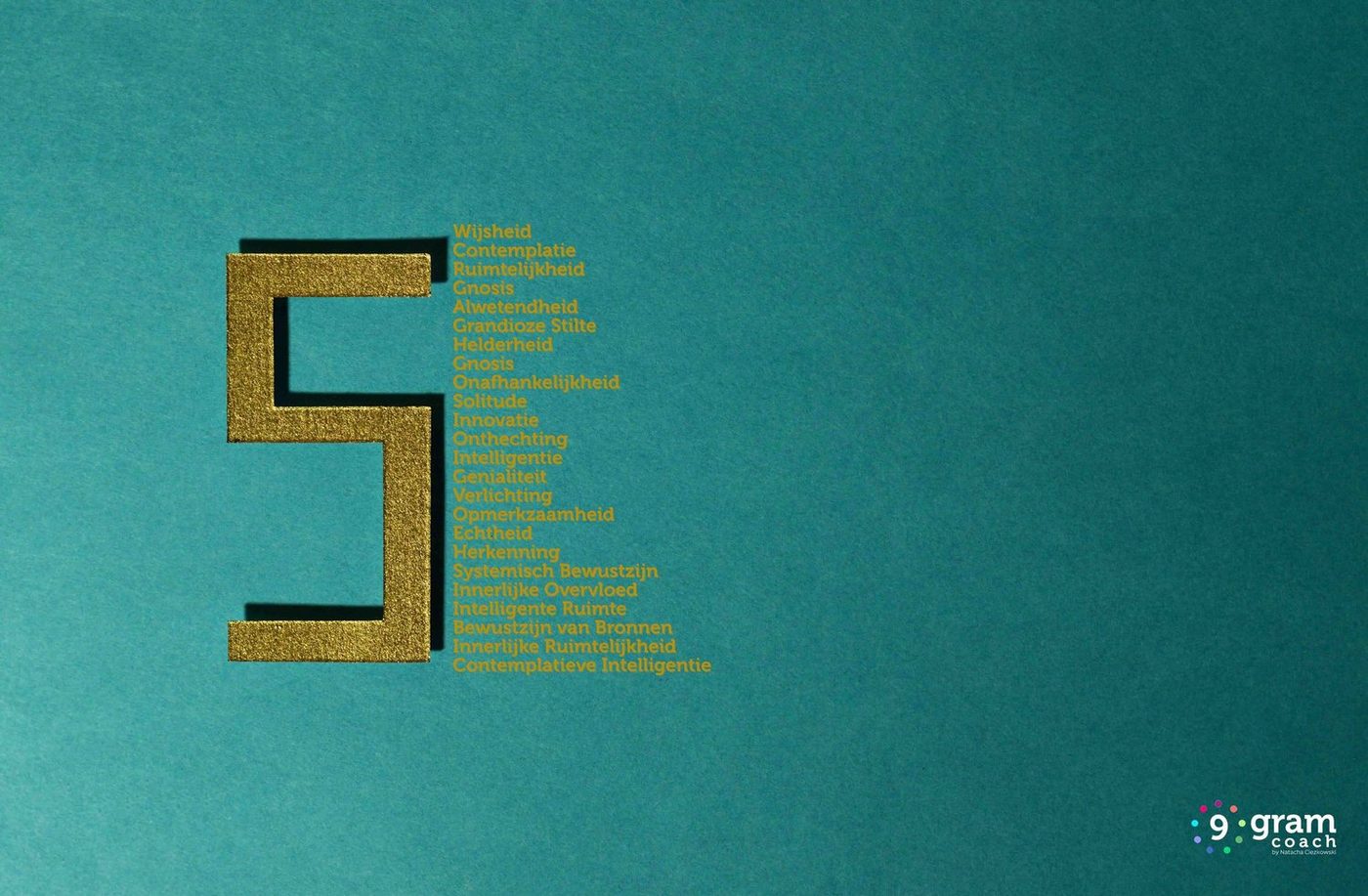
✪ Serenity ✪ Purity ✪ Cleanliness ✪ Goodness ✪ Objectivity ✪ Right Action ✪ Alignment ✪ Brilliance ✪ Willingness ✪ Backbone ✪ Positive Intention ✪ Integrity ✪ Self-Control ✪ Conscientiousness ✪ Methodology ✪ Steadfastness ✪ Reliability ✪ Precision ✪ Sustainability ✪ Balanced Refinement ✪ Structure & Flexibility ✪ Awareness of the Ideal ✪ Conscientiousness ✪ Discernment ✪
These examples illustrate that true perfection arises spontaneously when structures align with their natural laws. They show how order, efficiency and beauty can go hand in hand without force. This mirrors the Essence of Point One: when we let reality be as it is, an order unfolds that far exceeds our own attempts at control.
Pure Fixation – when the personality overshoots
The Enneagram pattern tries to imitate the natural order and purity of Point One through strictness and control. Instead of resting in the trust that everything falls into place, the personality assumes that the world is imperfect and must be improved. This leads to overcompensation.
Dirk Cloete describes how people who identify with Enneagram pattern One value principles and integrity. They feel the urge to be good and right, love standards and structure, and want to improve the world through their behaviour. When they are relaxed, they are tolerant, self-accepting and serene. As soon as the personality takes over, this strength shifts towards critical and unforgiving behaviour. Typical signs of fixation, which Uranio Paes and Beatrice Chestnut describe beautifully, are:
Overly critical and perfectionistic – the inner critic constantly focuses on what is wrong. The mind is fixated on ‘I must’ and ‘I should’, and standards become unattainably high.
Controlling and rigid – holding rigidly to rules and procedures; lack of flexibility; correcting others to prevent mistakes.
Self-critical and shame-filled – a relentless drive to improve; the inner dialogue consists of constant improvement and a ‘scorecard’ on which successes and mistakes are weighed up.
Suppressed anger and irritation – although Enneagram One feels a lot of anger, it is rarely expressed directly – with the exception of the ‘Sexual One’ subtype. Instead, the anger is suppressed and comes out as irritation, frustration or bitterness. The urge to be correct stops them from expressing anger, which creates tension.
Silencing natural impulses – according to Paes and Chestnut, the drive for perfection becomes a superego voice that suppresses spontaneous, animal impulses and tries to civilise everything. This creates a rigid and judgemental attitude towards oneself and others.
These fixations serve as defence mechanisms: by being strict with themselves and others, Enneagram One hopes to avoid their own vulnerability or shame. The limiting beliefs that ‘making mistakes is unacceptable’ and that ‘you are only valuable through hard work and control’ drive every facet of behaviour. Yet this attitude produces precisely the opposite effect: anger and judgement alienate them from others and from their own softness. Paradoxically, the natural order is undone by the very compulsive striving for improvement.
From anger to serenity
The way out of this fixation begins with recognising the suppressed anger and letting go of the need for control. The basic emotion of Enneagram One is anger, which usually appears as irritation or frustration. The virtue of Point One – Serenity – means being free from attachment to specific ways or outcomes and learning to move with the flow. I like to describe it as ‘accepting the world as it is and opening yourself in complete calm to whatever presents itself’. The transformation from anger to Serenity happens by becoming aware of the inner criticism and its effect on yourself and others. It calls for letting go of ‘must’, admitting imperfection and trusting that the world is perfect in its imperfection.
Beatrice Chestnut and Uranio Paes describe this process as the path from fear to acceptance: the tension between the Vice (or Passion) of Anger and the Virtue of Serenity eases when we let go of the preoccupation with self-judgement and ‘having to be good’ and open ourselves to inner peace. Dr David Daniels adds that all experiences, positive and negative alike, can arise freely without resistance when we are in contact with ‘Holy Perfection’. The need to improve others then disappears, and love becomes the basis of action. In that state, Enneagram One can apply the qualities of accuracy, discipline and integrity without harshness or moralism. They become principled, responsible and serene leaders who embody ‘right action’. Not because they want to control things. Because they sense what is needed at the right moment.
Conclusion
The story of Point One shows that true order does not come from force or criticism. It comes from surrender to the inherent order of life. In nature we find countless examples of efficient and harmonious structures: honeycombs that create maximum space with minimal means, sunflowers that arrange seeds in spiral patterns for optimal growth, snowflakes that follow hexagonal symmetry and planets that obey simple, elegant laws. These systems show that perfection is not a product of willpower, it is a manifestation of underlying principles.
When we allow our own Essence – the serene brilliance and purity of Point One – back in, a similar harmony arises. We then discover that ‘right action’ rises by itself from a clear source. The personality no longer needs to improve or judge; it may rest in trust. When we are fully present, says Almaas, we see the intrinsic perfection of reality and realise that nothing needs to be added or left out. The Pure Gold of Point One is therefore not an ideal to strive for, but a living quality that unfolds when we let the inner critic melt and surrender to the natural flow of life.
Sources:
Almaas, A. H. (2000). Facets of Unity: The Enneagram of Holy Ideas. Berkeley, CA: Shambhala Publications.
Diamond Approach / Ridhwan. (n.d.). Enneagram Type 1 – Brilliancy and Holy Perfection. DiamondApproach.org.
Dirk Cloete. (n.d.). Enneagram of Holy Ideas. Integrative9.com.
Dirk Cloete. (n.d.). Enneagram Type 1. Integrative9.com.
Daniels, David. (n.d.). The Nine Holy Ideas: Type 1 – Holy Perfection & Serenity. Enneagram Worldwide.
Chestnut, Beatrice, & Paes, Uranio. (n.d.). Type 1 – The Reformer: Archetype, passion and virtue. CP Enneagram.
Pau Atela, Christophe Golé, Scott Hotton. (2002). A dynamical system for plant pattern formation: a rigorous analysis.
Riso, Don, & Hudson, Russ). (n.d.). Type One – The Reformer. EnneagramInstitute.com.
Qiancheng Zhang, Xiaohu Yang, Peng Li, Guoyou Huang, Shangsheng Feng, Cheng Shen, Bin Han, Xiaohui Zhang, Feng Jin, Feng Xu, Tian Jian Lu. (2015). Bioinspired engineering of honeycomb structure – Using nature to inspire human innovation. Progress in Materials Science |
Thomas C. Hales. (2002). The Honeycomb Conjecture. Discrete Computational Geometry.
Libbrecht, Kenneth G. (2007). The Formation of Snow Crystals. American Scientist, 95(1).
Valentin Grob, Evelin Pfeifer, Rolf Rutishauser. (2007). Sympodial Construction of Fibonacci-type Leaf Rosettes in Pinguicula moranensis (Lentibulariaceae). Annals of Botany, Volume 100, Issue 4, October 2007, p857–863.
Wikipedia. Kepler’s Laws of Planetary Motion.