Nine is one of the Nine temperaments that are naturally present in all of us: everyone has equal access to each of these nine temperaments. It may be that your personality puts more or less focus on some of them.
In this series I explore the Nine Essential Qualities of the Enneagram. For each point I describe the universal Essence –the ‘Pure Gold’ that is present in each of us– and examine how our personality distorts that quality into a pure fixation. This essay is about Point Nine -translated by the personality into ‘Enneagram 9’, a set of patterns we also call the Adaptive Mediator or Peacemaker. For Nine, the Gold is all about Right Action and engagement: the willingness to act from presence as part of the whole. I show how this strength appears in nature and how Enneagram pattern 9 tries to imitate this quality through passivity or avoidance.
Essence -Pure Gold
Right Action and Engagement
In the classical Enneagram tradition, Essence is seen as our innate, true nature –a core of aliveness and presence that precedes our learned personality. For Point Nine, this essence is a quality of Right Action or Engagement: a spontaneous willingness to act from the true self and to remain engaged with the whole. A.H. Almaas and Dr. David Daniels thus name ‘Holy Love’ as the higher idea and ‘Right Action’ as the Virtue of Nine. Holy Love describes an unconditional love in which everyone belongs; Right Action refers to appropriate, proactive action that respects oneself and others. This state is about a deep sense of connectedness that leads to harmonious movement.
Facets of the Pure Gold
The Essence of Nine has several facets. In the body it is felt as presence – being fully present and resting in pure being and inner peace. Mentally it brings an understanding of unity and harmony and an awareness that you are part of a greater whole in which everyone is of equal worth. Emotionally it expresses itself as benevolence, oneness with oneself and flow – a natural stream of energy without force. Other facets are boundlessness and acceptance, receptivity and patience, adaptability and fairness. A deep knowing that ‘everything belongs to everything‘. These qualities suggest an open, spacious awareness that leaves room for oneself and others alike. Russ Hudson describes the core qualities of Nine as, among other things, Wholeness, Unity and Flow, and David Daniels emphasises that the Essence of Nine is to live in a state of Holy Love and to engage in Right Action. I see it myself as an inner riverbed in which one feels connected to everything and yet, as a human being, is clearly present from an individual unity within the whole. As soon as we allow this sensation, we can tap into this potential: Pure Gold, present in us, which gives us the gift of facilitating unity, balance and harmony.
Universal life force as prana or chi
This essence is not unique to humans. Spiritual traditions describe the underlying energy as prana or chi, the life energy that flows through all beings and keeps them in balance. When we experience the Essence of Point Nine within us, we can feel in our body that this energy can flow freely through us when we open up and take our place in the whole. As the biologist Anupama Sapkota describes, the body continually creates a dynamic equilibrium in which diverse processes respond to one another to maintain a stable state -homeostasis. This dynamic equilibrium is a beautiful metaphor for the Essence of Nine: constantly in motion and yet balanced, attuned to feedback from the environment. In the following paragraphs I show how this principle is visible in nature.
Examples from nature and the universe
Cooperation and symbiosis in ecosystems
In nature, countless examples of cooperation and harmony can be found that reflect the Essence of Nine. Ecologists have identified various forms of symbiosis. Mutualism –in which both partners benefit– is visible, for example, in the relationship between sea anemones and clownfish; the fish protect and clean the anemones, while finding protection themselves among the tentacles. Commensalism occurs with epiphytes such as orchids that grow on trees without harming them. Commensal birds, such as cattle egrets, eat parasites and insects around grazing mammals and so offer mutual benefits. Even our own gut flora lives in mutual cooperation: bacteria help us digest food while we offer them housing. These relationships illustrate how different species live together in a dynamic balance; everyone contributes and receives what is needed without dominating the other.
Other forms of cooperation go beyond mutual benefit. Dolphins have helped people with fishing or with rescuing swimmers, which shows that altruism occurs in nature. All these examples underline that life on earth is built on networks of connections; no species evolves alone but always within ecosystems and relationships. Point Nine reflects this connectedness and can learn that engagement is not a disturbance but a natural consequence of the fact that everything is interconnected.
Balance and resilience of ecosystems
A balanced ecosystem never stands still. It is a dynamic equilibrium in which the composition and relationships of organisms are constantly changing while the system as a whole remains resilient. A healthy ecosystem recovers again and again after disturbances such as fire or storm; the greater the biodiversity, the greater the resilience to return to the original state. This reflects the quality of Point Nine to stay in flow and to pick oneself up again after setbacks, without losing the connection with the whole.
Dynamic equilibrium in the human body
Our own physiology illustrates this harmony too. Homeostasis is the ability of living systems to maintain a constant internal state by keeping opposing processes in balance. In thermoregulation, for example, a rise in body temperature registers as a stimulus; sensors pass this on to the control centre in the hypothalamus, which then activates sweat glands to cool the body down. This is a negative feedback loop in which the response reduces the deviation. Other homeostatic processes are the maintenance of blood pressure, acid-base balance and blood sugar level. These examples show that true harmony is not static but a continuous process of adjusting –exactly as, thanks to the essence of Point Nine within us, we move effortlessly with life, in good times and in bad, while keeping our centre.
Collective movement: schools of fish
Another fascinating example of natural harmony can be seen in the collective movement of animals. Schools of fish move through the water like one flowing cloud without central leadership. Each fish has no idea where it is within the overall structure, but instinctively keeps an equal distance from its neighbours and follows any change of course at lightning speed. With sharp senses –eyes, hearing and a sensitive lateral line– they register vibrations and movements of their fellows, so that the group synchronises without collisions. Beautiful. Breathtaking. Together the fish form an imposing, streamlined cloud that deters predators; it is hard for a hunter to isolate a single individual and the whirlwind of fins and scales causes confusion. Clever! The group also helps with finding food: more eyes spot more prey, and schools can encircle a prey. Research by Princeton University and partners even shows that fish in a school swim faster and use less energy thanks to hydrodynamic interactions –comparable to cyclists in a peloton. The waves that fish make in a school are also said to cancel each other out, so that they move more quietly through the water; this reduces the chance of predators noticing them. In short: a school is a self-organising collective in which individual fish continually adjust their position in order to function as one whole.
Flocking birds as a unity
A similar phenomenon takes place in the air with flocks of birds, such as starlings or swallows forming spectacular patterns: murmurations. These often arise when a bird of prey appears at the edge of the flock; the birds react by moving in intricate patterns to create distance from the predator. As with fish, there is no leader: the behaviour of the flock is determined collectively because each bird follows the movements of its nearest neighbours. Scientists have discovered that starlings in a murmuration spread information across the whole group almost without loss; when one bird changes direction, the others react almost simultaneously, so that the group moves as one. Each bird aligns its own flight with about seven direct neighbours –an optimisation that keeps the flock together without chaos. The purpose is manifold: the large moving whole extends the perceptual range so that predators are noticed sooner and confusion arises during attacks, it offers warmth and shelter when the group roosts together overnight and, through the so-called dilution effect, it lowers the chance of any single bird being caught by a predator. The visual spectacle also attracts other birds to join, which increases the protection. Murmurations are so refined that researchers describe them as a physical phenomenon of scale-free correlation: each bird responds to the group as a whole and yet nobody is in charge. This self-organising coordination –at once flexible and precise– is a mirror for Point Nine: it shows how harmony arises when individuals take their place within a larger whole without losing the connection.
Pure fixation from Enneagram pattern Nine
When the Essence cannot flow freely, it is because the personality structure of Enneagram pattern Nine acts as armour. A survival mechanism arising from the perception that contact with our Essence has been broken, as Julie Harris describes it. Children who grow up with a preference for Enneagram pattern 9 learn early on that it is safe to adapt and avoid conflict. They would rather withdraw than make their needs known. The deep sensitivity and harmony of the Essence is then imitated in pseudo-harmony and covered up by passivity and self-forgetting. Instead of responding naturally to what is true, the personality tries to keep the peace by disturbing nothing –which leads to the passion of Nine: acedia, often translated as laziness, and better translated as self-forgetting. Christopher Heuertz writes that this ‘sloth’ is not merely laziness but rather a loss of contact with the body, which leaves people who identify with Enneagram pattern Nine (henceforth called ‘Enneagram 9’) feeling tired and dulled.
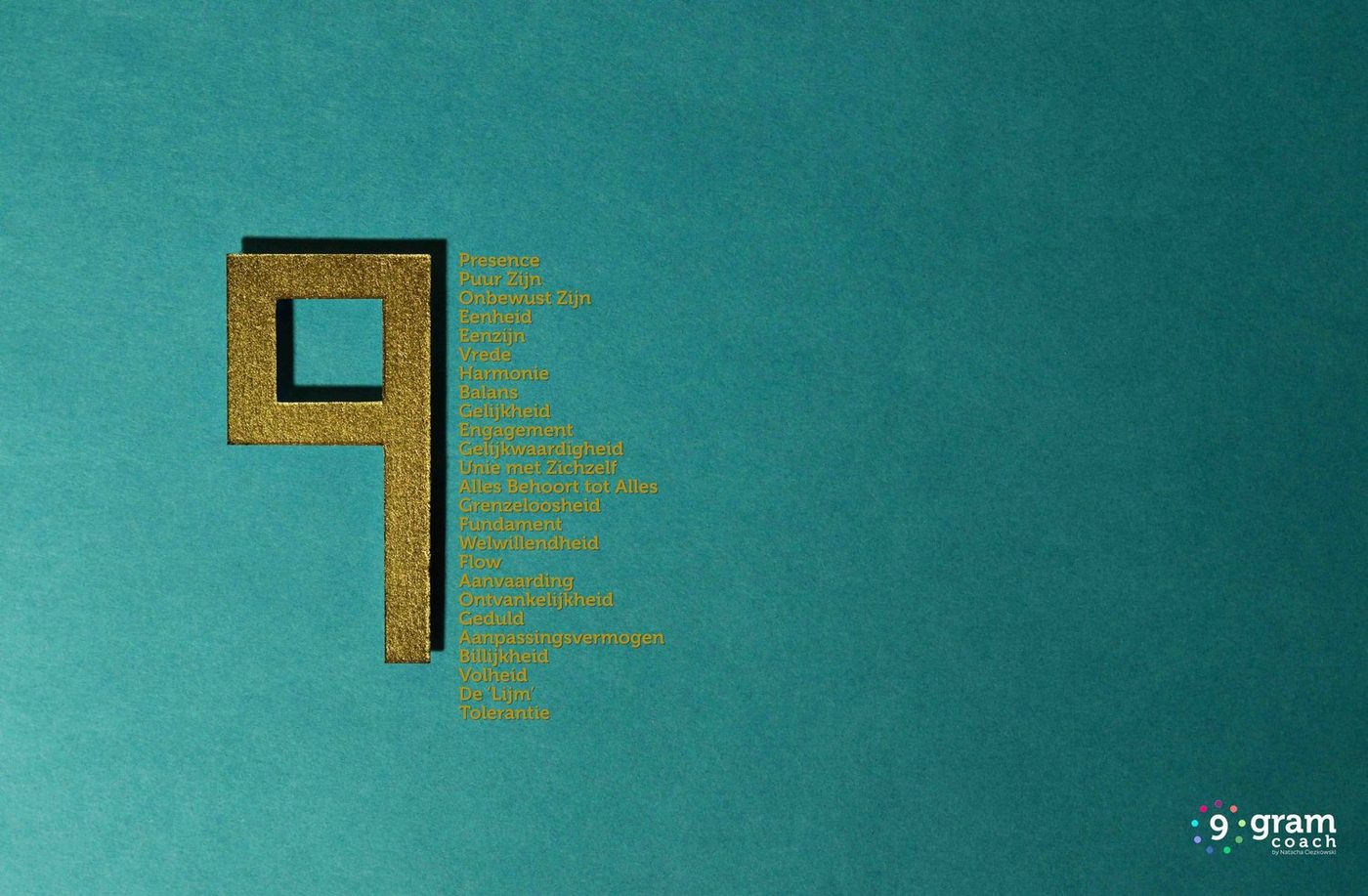
✪ Presence ✪ Pure Being ✪ Peace ✪ Unconscious Being ✪ Unity ✪ Oneness ✪ Harmony ✪ Balance ✪ Equality ✪ Engagement ✪ Equal Worth ✪ Union with Oneself ✪ Everything Belongs to Everything ✪ Boundlessness ✪ Foundation ✪ Benevolence ✪ Flow ✪ Acceptance ✪ Receptivity ✪ Patience ✪ Adaptability ✪ Fairness ✪ Fullness ✪ The ‘Glue’ ✪ Tolerance ✪
Patterns of avoidance and passivity
Avoidance of conflict and confrontation: To avoid tension, Enneagram 9 postpones difficult conversations and adapts to others. They often go along with the wishes of others to keep the peace. This leads them to suppress their own opinions and needs, which in Enneagram jargon is described as the Vice of Self-forgetting.
Passivity and procrastination: Enneagram 9 tends to postpone decisions or leave projects lying around. They stay neutral while action is needed, so that opportunities are lost. The Enneagram Institute notes that Enneagram 9 plays down problems to avoid tension and therefore prefers to stay on the sidelines.
Self-forgetting and over-adaptation: In an attempt to preserve harmony, Enneagram 9 loses contact with their own wishes. They deny their own opinion and conform to the priorities of others, so that their original identity fades. Enneagram 9 does not consider themselves important and becomes passive as a result.
Numbing and escapism: To avoid feeling stress, Enneagram 9 often seeks comfort in routines. Depending on the Subtype of Nine, this might be food, watching TV, gaming, intense exercise, merging with other people's agendas, workaholism, daydreaming, … Anything that distracts attention from Right Action for themselves. Unhealthy Enneagram 9s also show escapism and apathy in order not to face problems.
False harmony and hidden frustration
These patterns resemble the Pure Gold but are in fact an overcompensation. By staying calm and compliant on the surface, Enneagram 9 loses the connection with their own Life Force (Point 8). As a result they freeze into passivity and their accumulated anger comes out passive-aggressively. The Enneagram Institute points out that Enneagram 9s tend to ignore the ‘dark side’ of life and to simplify reality, and that real growth is only possible when they are willing to face these suppressed feelings. This overshadowing of the Essence is what I call ‘pure fixation’: a fixated personality strategy that tries to reproduce the core quality from a positive intention and ends up achieving the opposite. The inner saboteur of Pure Gold.
Reflection: from survival to embodiment
Trusting Holy Love and Right Action
For Enneagram 9, the way back to the original Essence begins with recognising these patterns of self-forgetting and daring to restore contact with the inner body. Dr. David Daniels writes that the higher qualities of Nine –Holy Love and Right Action– mean that Enneagram 9 feels loved and connected to everything, which makes them feel safe not to lose themselves. In that state, action is no longer driven by fear of conflict but by an inner impulse to do what is right for themselves and for the whole. Enneagram 9 can practise with small steps: consciously voicing an opinion, giving priority to their own desires, having an uncomfortable conversation. Relaxing the body and breathing helps to release the tension of the harness and to come back into contact with the life force.
Setting boundaries and being engaged
Essence does not ask you to merge with everyone, but to take both yourself and the other seriously. Setting boundaries and saying ‘no’ are therefore crucial expressions of loving engagement. By consciously making contact with their own desires and acting decisively, Enneagram 9 discovers that harmony springs from truth and that conflict is sometimes necessary for growth. By rising above the tendency towards passivity, room appears for the Virtue of Nine: Right Action. The ability to be calm and grounded while taking clear steps. Daniels describes how this combination helps Nine to ‘act with appropriate force’ and to see the truth of every person, including themselves. Note: in the Essence of Nine we actually speak of boundlessness, since there are no boundaries when we follow the natural flow. As soon as our personality is triggered, we deal with the concept of ‘boundaries’ in a fixated way.
Embodied harmony
An embodied Enneagram 9 radiates a serene strength. They are able to be active without rushing, and passive without numbing –a powerful calm. In relationships, an embodied Enneagram 9 is often the glue that holds groups together. Not by avoiding conflict but by being present in a fair and empathic way. They realise that their voice is just as valuable as that of others and that their actions matter. Just like in a healthy ecosystem, Enneagram 9 knows in Essence when to intervene and when to trust the self-healing capacity of the whole. This is how the Pure Gold of Point Nine comes to life: a deep inner peace that invites others into authenticity, coupled with a willingness to stand up for the whole where necessary.
Conclusion
Point Nine reminds us that real harmony is not passivity. It is a dynamic balance between rest and action. The Essence of Nine –Holy Love and Right Action– invites us to be fully present and to take part in life as a full member of the whole. When the personality tries to imitate this quality through conflict avoidance and self-forgetting, a fixation arises that actually stiffens us. By approaching themselves and others with loving truth, Enneagram 9 -in each of us!- can find the way back to our natural calm and thereby become a source of connection and justice for the world.
Russ Hudson puts it this way: When we reach that level, we realise to our amazement that the qualities we were looking for are already present in us. We understand that we were looking in the wrong place all along: everything we need for our growth and wholeness as human beings lies hidden in our Essential nature and has always been available.
Sources:
A.H. Almaas. Facets of Unity: The Enneagram of Holy Ideas. (2000).
Alfano, A. (2013, 21 February). How Do Starling Flocks Create Those Mesmerizing Murmurations? Cornell Lab of Ornithology – All About Birds.
Langen, T. (2022, 31 March). Why do flocks of birds swoop and swirl together in the sky? A biologist explains the science of murmurations. The Conversation. (Rewritten and distributed via Big Think).
Onze Natuur. (2021, 31 August). Waarom vissen in een school zwemmen. OnzeNatuur.be.
Sportvisserij Nederland. (2024). Wist je dat? Vissen zwemmen niet alleen in scholen voor veiligheid. SportvisserijNederland.nl.
Daniels, D. (n.d.). Type 9: Peacemaker – Holy Love & Right Action. Enneagram Worldwide.
Julie Harris. Teaching in Enneagram Certification Program in Conscious Living, 2021-2022.
Liang Li, Máté Nagy, Jacob M. Graving, Joseph Bak‑Coleman, Guangming Xie and Iain D. Couzin. 2020. Vortex phase matching as a strategy for schooling in robots and in fish. Nature Communications (volume 11, article 5408). Max Planck Institute of Animal Behavior, University of Konstanz, College of Engineering of Peking University, Hungarian Academy of Sciences and Princeton University.
Riso, D., & Hudson, R. Type Nine – The Peacemaker. Enneagram Institute.
Riso, D., & Hudson, R. The Wisdom of the Enneagram: The Complete Guide to Psychological and Spiritual Growth for the Nine Personality Types. (1999).
Heartfulness Magazine. Cooperation in Nature. Heartfulness Magazine.
Enel Green Power. What is an ecosystem? Balance and resilience. EnelGreenPower.com.
Encyclopaedia Britannica. Homeostasis. Britannica.com.