The Enneagram describes nine fundamental ways in which people experience themselves and the world. This essay focuses on ‘Five’, one of the nine natural temperaments present in every human being. Everyone therefore has access to its qualities, although our personality structure will emphasise some of them more strongly than others. Within each point lies an essence: innate qualities that the personality ‘imitates’ as a survival strategy, causing us to lose contact with them. We therefore dive deeper into the essence of the natural 'Point Five' (what I call Pure Gold) on the one hand, and into the way our personality distorts this essence into the 'Enneagram pattern Five' (the personality fixation) on the other. In earlier essays I explored Point Eight (Vitality), Nine (Unity), One (Purity), Two (Exchange), Three (Worth) and Four (Original Identity).
Point Five stands for a primal principle of Intelligent Space, Wisdom and Awareness of Resources. I first explore these universal qualities, as well as principles such as Contemplation, Spaciousness and Gnosis. I then describe how the personality tries to secure them through withdrawal and accumulation. What happens when inner abundance is narrowed into fear of scarcity? Finally, I offer a reflection on the movement from survival to embodiment.
Essence – Intelligent Space as Pure Gold
One way to describe the essential qualities of Point Five is as Inner Spaciousness: a state in which experience can appear without having to be interpreted or controlled immediately. This space is not empty, it is potential. In Enneagram jargon, Point Five is also linked to the ‘Holy Idea’ (a mental concept that acts as a life compass) of Holy Omniscience (Almaas, 2002): the insight that consciousness intrinsically has access to knowledge because it is itself part of an intelligent universe. Wisdom does not appear here as something to be collected. It appears as something that reveals itself when the mind becomes quiet enough. This brings forth a quality of Grand Silence, which is not emptiness but a field in which perception leads to Clarity. In this state arises what we might call Contemplative Intelligence: the ability to remain with perception without reacting immediately.
Wisdom, Clarity and Gnosis
When Point Five is lived in essence, knowledge appears as integration. Wisdom here is not intellectual superiority; it is a lived Clarity that lets us see without distortion. Gnosis refers to direct inner knowing — knowing without reasoning. In this state there is a subtle trust that energy circulates and that resources do not dry up when they are shared. It is an Awareness of Resources, in which the mind, instead of a defensive instrument, becomes a refined sense organ.
Independence without isolation
Point Five also carries a natural quality of Independence – which is not detachment. It is an inner autonomy that makes real participation possible: how can you be involved without losing yourself? Solitude is nourishing here because it restores Clarity. As Damasio describes, consciousness arises in the dynamic relationship between organism and environment. Autonomy is therefore never absolute; it is always relational.
Innovation and systemic insight
Another expression of the Pure Gold of Five is Systemic Awareness: the ability to recognise patterns and see connections that others miss. From this open curiosity, Innovation arises. Not because you want to be different. Because you look more deeply. Because you give space to Attentiveness, which in turn leaves room for the Recognition of Authenticity. It is a source of natural Intelligence that is the foundation of Genius and Enlightenment.
Mirrors in nature and the universe — intelligence without accumulation
The desert night — the intelligence of temperature regulation
In deserts it can be extremely hot by day and cool sharply at night. Many animals and plants have adapted by shifting their activity to cooler periods. This is not passivity, it is energy intelligence. They use space and timing as a strategy to survive without wasting energy. Wisdom is knowing when not to move. Nature shows here that survival does not happen through constant action but through selective participation.
Hibernation in mammals — deliberate withdrawal in order to conserve
Bears, bats and squirrels go into hibernation. Their metabolism slows drastically. This is not standstill, it is highly organised biological regulation. The body conserves energy, restructures and prepares for later activity. Withdrawal can be nourishing when it remains connected to cyclical participation – the fixation of Enneagram Five would choose isolation here. The essence of Point Five shows rhythmic autonomy.
Spiral structures in galaxies — form through space
Spiral galaxies such as the Milky Way exist not in spite of emptiness but thanks to emptiness. The vast interstellar space makes rotation and stability possible. Without space there is no structure. Space is an organising intelligence – not a lack. Inner stillness functions in the same way: it makes complex thinking possible.
Echolocation in bats — knowledge arises relationally
Bats navigate not by sight but by sound waves that return to them. Their knowledge of the world arises through resonance. They know their surroundings because they interact with them. Not because they store information. Knowing arises through contact, not through accumulation. This is an extremely strong biological model for ‘participatory intelligence’.
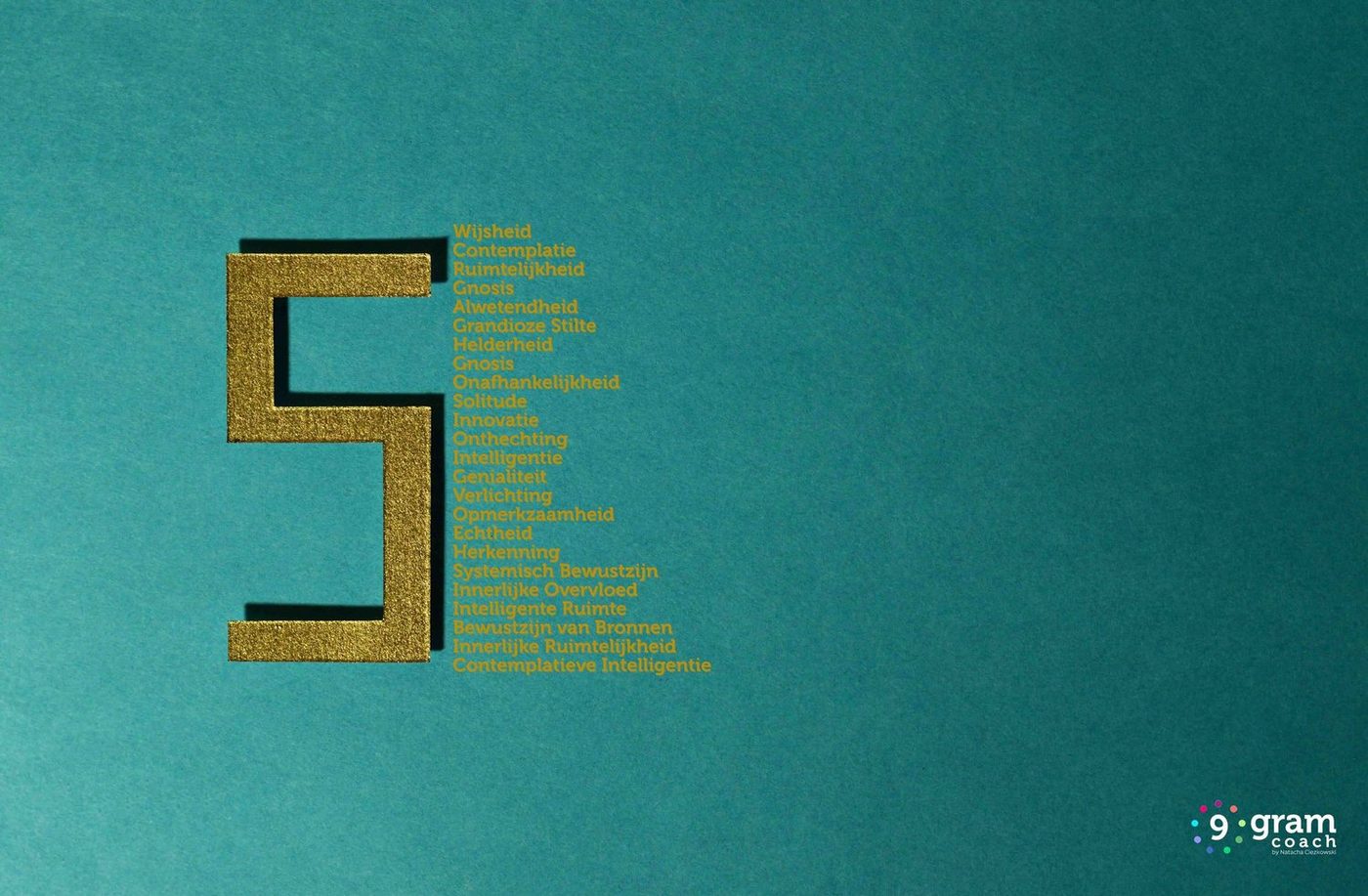
✪ Intelligent Space ✪ Wisdom ✪ Awareness of Resources ✪ Contemplation ✪ Spaciousness ✪ Gnosis ✪ Inner Spaciousness ✪ Omniscience ✪ Grand Silence ✪ Clarity ✪ Contemplative Intelligence ✪ Gnosis ✪ Independence ✪ Solitude ✪ Systemic Awareness ✪ Innovation ✪ Detachment ✪ Intelligence ✪ Genius ✪ Enlightenment ✪ Attentiveness ✪ Authenticity ✪ Recognition ✪ Inner Abundance ✪
Mycorrhiza — shared knowledge fields
Beneath forests, fungal networks function as circulating information systems. Trees share nutrients and signals. No single tree owns the network. Intelligence appears here as a relational field.
Octopuses — solitary and yet intelligently connected
Octopuses live largely alone, and show exceptional cognitive flexibility. Their intelligence is adaptive, not dependent on social confirmation. Solitude can therefore be a source of creativity.
Ant colonies — distributed intelligence
Ants act on the basis of local signals, and together a complex system emerges. Knowledge here is dispersed, not centralised.
Cosmic expansion — space as a condition for form
According to modern cosmology, structure only arises through expansion. Space is not an absence, it makes differentiation possible.
From Essence to personality — when abundance seems scarce
As with every point, personality arises when essence cannot flow freely. With Five, this happens through the belief: “There is not enough.” Not enough time. Not enough energy. Not enough knowledge to be safe. Natural contemplation then becomes withdrawal. Independence becomes isolation. Wisdom becomes hoarding information. The Enneagram describes the Vice (Passion) of Five as Avarice – an existential stinginess with energy.
Intense thinking as protection
When thinking becomes a shield, the result is overanalysis, emotional distance, minimising involvement, invisibility in groups, cynicism or intellectualisation. The paradoxical effect is that by wanting to conserve energy, life actually becomes smaller.
Pure Fixation — knowledge as a substitute for participation
What is crucial here: the personality wants the same thing as the essence. It wants safety, clarity and autonomy. It simply seeks them through control. It tries to guarantee abundance by closing itself off. It tries to attain wisdom by accumulating. And precisely because of that, scarcity arises.
Return — Detachment and circulation
The movement back is subtle. Not more action, not more knowledge – but trust in circulation. Detachment means: being present without answers, sharing wisdom without a need to prove yourself, being involved without over-identifying, letting energy flow in interaction. When this shift takes place, stillness becomes creative again and thinking becomes light again – the heaviness dissolves.
Phenomenological deepening — permeable identity
Phenomenologically speaking, the self is not a closed entity but a dynamic boundary. The fixation of Enneagram Five tries to harden this boundary. Only: consciousness remains relational and intelligence does not appear in isolation. It appears in contact without loss of inner space. That is our true autonomy in Point Five.
Closing reflection: Point Five as a reminder of inner abundance
In biological systems, neural networks and cosmic processes we see the same principle: intelligence grows through circulation. When the personality relaxes, the Pure Gold of Five appears by itself: Wisdom. Clarity. Space. Innovation. Contemplation. Gnosis. It appears as presence (Presence) – not as possession.
Perhaps that is the deepest truth of Point Five: that what we try to protect by withdrawing only deepens when we dare to take part.
Sources
Altringham, J. D. (2011). Bats: From evolution to conservation. Oxford University Press.
Almaas, A. H. (2002). Facets of unity. Shambhala.
Binney, J., & Tremaine, S. (2008). Galactic dynamics (2nd ed.). Princeton University Press.
Carey, H. V., Andrews, M. T., & Martin, S. L. (2003). Mammalian hibernation: Cellular and molecular responses to depressed metabolism and low temperature. Physiological Reviews, 83(4), 1153–1181.
Cloudsley-Thompson, J. L. (2001). Thermal and water relations of desert beetles and other arthropods. Springer.
Damasio, A. (1999). The feeling of what happens. Harcourt.
Geiser, F. (2004). Metabolic rate and body temperature reduction during hibernation and daily torpor. Annual Review of Physiology, 66, 239–274.
Hanlon, R. T., & Messenger, J. B. (2018). Cephalopod behaviour. Cambridge University Press.
Hölldobler, B., & Wilson, E. O. (2009). The superorganism. Norton.
Merleau-Ponty, M. (1962). Phenomenology of perception. Routledge.
Naranjo, C. (1994). Character and neurosis. Gateways.
Riso, D., & Hudson, R. (1999). The wisdom of the Enneagram. Bantam.
Siegel, D. J. (2012). The developing mind. Guilford.
Simard, S. (2021). Finding the mother tree. Knopf.
Schmidt-Nielsen, K. (1997). Animal physiology: Adaptation and environment (5th ed.). Cambridge University Press.
Schnitzler, H.-U., & Kalko, E. K. V. (2001). Echolocation by insect-eating bats. BioScience, 51(7), 557–569.
Weinberg, S. (1977). The first three minutes: A modern view of the origin of the universe. Basic Books.
Capra, F., & Luisi, P. (2014). The systems view of life. Cambridge.
Prigogine, I., & Stengers, I. (1984). Order out of chaos. Bantam.