Two is one of the Nine temperaments that are naturally present in all of us: everyone has equal access to each of these nine temperaments. It may be that your personality puts more or less focus on some of them.
In the Enneagram tradition, the nine Points are seen as different clusters of essential qualities that are already naturally present in us. These core qualities are what I call the ‘Pure Gold’: a source of aliveness, love and awareness that does not need to be created or controlled by the personality. After the essays on intelligent action in Point Eight, Point Nine and Point 1, this piece focuses on Point Two –the Point of Giving & Receiving in Equal Worth. In other words, the Point of Love.
Enneagram pattern Two feels called to give and to help others; in its healthy form this is an embodiment of genuine warmth and connection. When this striving springs from hidden expectations, however, it can tip over into manipulation, over-involvement and a sense of self-importance. This essay explores three aspects:
Essence – Pure Gold: the original qualities of Point Two, in which giving and receiving take place in equal worth.
Examples from nature: how these qualities become visible as natural principles in the animal and plant kingdoms, without any coercion or manipulation.
Pure Fixation: how the personality, through Enneagram pattern Two, tries to imitate these qualities and thereby overshoots into the opposite.
Essence – Humility and Merging Love
Merging Love: connected without fusing
According to A.H. Almaas, every Enneagram point has an essential ‘endowment’ – a quality of Essence that expresses the core energy of that Point. For Point Two this is Merging Love, also called ‘Merging Gold’. This quality is described as a ‘melting love that is beyond emotion – it is the fundamental ground of love that sustains the essence of relationships’, in Almaas's words. It is a state of presence in which boundaries soften, creating a sense of not being separate from others and the world. Merging Love does not depend on personal stories or conditions; it is a radiant, warm presence in which mutual nourishment and freedom go together. Almaas writes that when we experience this quality, we realise that we do not stand apart: relationships then feel fulfilled because we experience the connection between us directly. At the same time, Merging Love contains enough independence and flexibility to explore and transform egoic patterns.
Holy Will / Holy Freedom and the Virtue of Humility
Besides this affective quality, Point Two has a higher mental quality (Holy Idea) and a higher emotional quality (virtue). In the Diamond Approach, the Holy Idea of Point Two is called Holy Will or Holy Freedom. It refers to the insight that our own willing is not separate from the universal will; freedom comes from fully going along with the unfolding of the universe. This means there is no inner struggle any more: ‘your will and the will of the universe are completely merged and unified, so there is no inner discord’. Dr. David Daniels explains this as Holy Freedom, in which the real needs of self and other are fulfilled by a will greater than our own. When we let ourselves fall into this natural stream, intrapersonal freedom arises to give and to receive without pride or an agenda of our own. In that state the heart feels humble, grateful and free of manipulation; love flows without any need to intervene.
The accompanying virtue of Point Two is Humility. According to Almaas, humility means seeing yourself and your capacities clearly within a larger whole. I like to describe it myself as ‘Knowing that everyone is important and has self-worth, and so giving and receiving in equal worth’. Dirk Cloete of Integrative Enneagram Solutions describes how, when someone who identifies with Enneagram Two is in balance, they give unconditionally without diminishing their own worth or that of others. Humility makes it possible to act without attachment to pride: we may give … or not, depending on our own needs and those of the other, according to Dr. David Daniels. This quality invites us to embrace both the joy of giving and the discomfort of receiving – and to know that everyone is valuable, regardless of what you give or receive.
Facets of Pure Gold
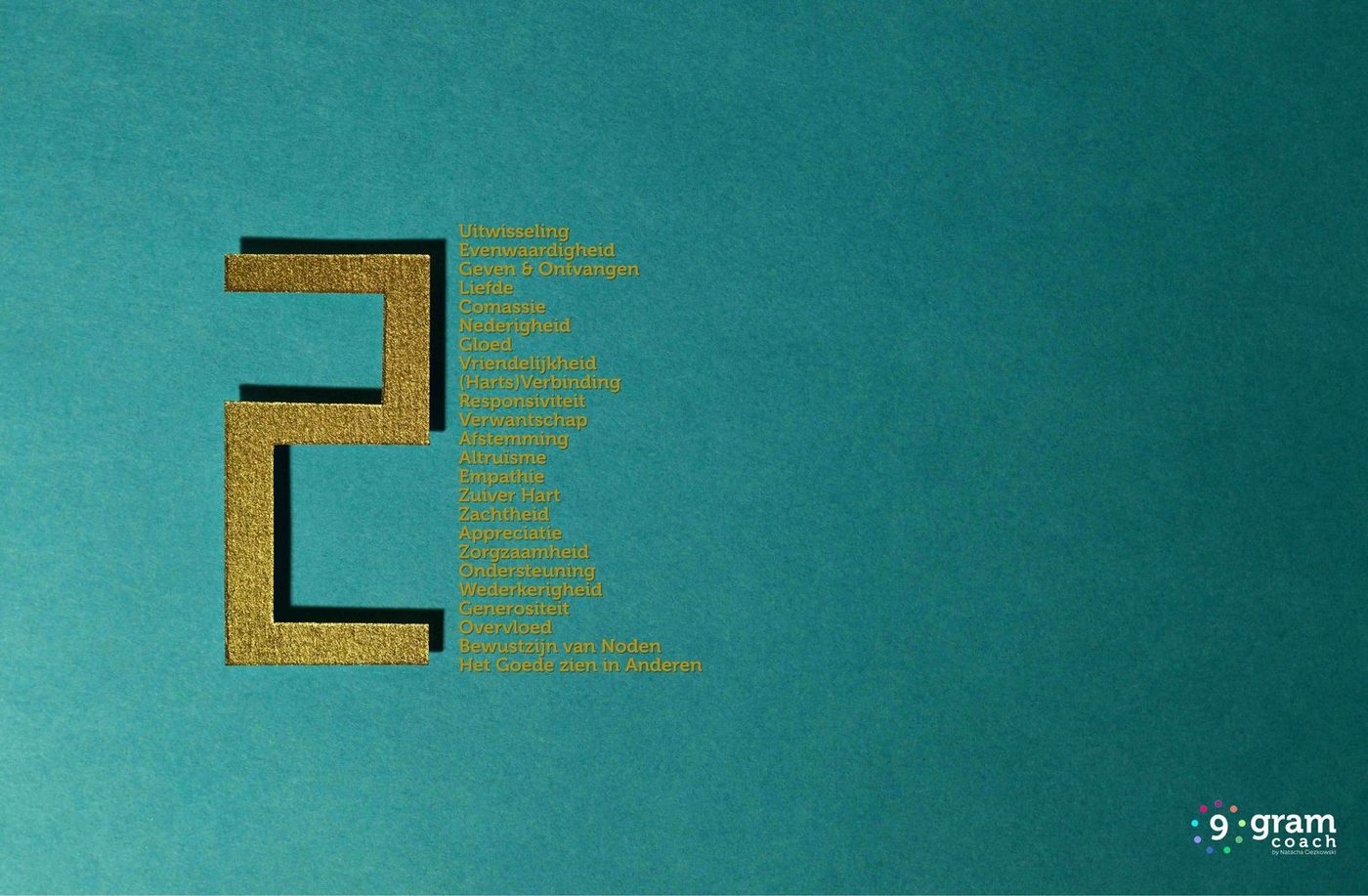
In my own ‘Pure Gold’ programme and the visuals shared here, the essence of Point Two is summarised in qualities such as:
Exchange and Equal Worth: the realisation that giving and receiving are of equal value; we create no hierarchy by helping but acknowledge the other as equally valuable.
Love and Compassion: a warm passion that sees the other as they are and recognises the best in people.
(Heart) Connection and Kinship: the ability to make deep contact, to be attuned to the needs of the other while remaining connected to yourself.
Responsiveness and Attunement: a sensitivity to what is needed, without getting bogged down in overprotection or people-pleasing.
Altruism and Empathy: a natural inclination to contribute to the wellbeing of the community; empathy is strongly developed.
Generosity and Abundance: the ability to give from a sense of abundance instead of scarcity.
Gentleness and Caring: a tender, nurturing presence that offers support without losing your own boundaries.
Awareness of needs: recognising and respecting both your own needs and those of others.
Reciprocity and Appreciation: the willingness to receive care yourself and to show gratitude for what you are given.
These facets make it clear that the essence of Point Two is about equality, connection and a pure heart, not about dependent love or unsolicited help. When these qualities can flow freely, Enneagram Two embodies a friendly, caring and warm presence that inspires others to be themselves. Pure Gold reminds us that true love is never manipulative; it is a natural state of connection that leaves room for mutual growth.
Examples from nature and the universe
Pistol shrimp and goby: partners in reciprocity
In nature we find countless examples of symbiotic relationships in which mutual giving and receiving are central. A classic example is the mutualistic relationship between the pistol shrimp and the goby. The shrimp is a keen digger and maintains a shared shelter in the seabed; the goby acts as a lookout. The shrimp usually keeps one antenna on the fish to feel warning signals. When the goby sees a predatory fish, it darts to the safe entrance and warns the shrimp. Only when the goby comes out does the shrimp also venture outside – a beautiful example of trusting coordination. The shrimp also benefits from food such as parasites on the fish's body. Both animals receive and give, without either of them sacrificing themselves; in this way they illustrate the essence of equal partnership.
Ants and aphids: protection and reward
A second example is the symbiosis between ants and aphids. Aphids produce honeydew – a sweet substance that is a by-product of their diet. Some ant species ‘milk’ the aphids by gently tapping them with their antennae and protect the aphids from predators. Ants even move eggs and nymphs to their nest to maximise the harvest. The aphids receive protection; the ants receive nourishment. This relationship illustrates how both parties flourish thanks to reciprocal care and how ‘seeing the good in the other’ literally has nutritional value.
Mycorrhizal networks: the wood‑wide web
On a larger scale, forests show how shared life energy works. Scientists discovered that trees exchange water and nutrients via underground fungal networks (mycorrhiza) and give warnings about drought or insect attacks via chemical signals. Tree roots connect with microscopic fungal threads that function as a communication network; in exchange for sugars from the trees, the fungi supply nitrogen, phosphorus and other minerals. This ‘wood‑wide web’ shows a natural equality: trees help each other survive and protect the community as a whole, while the fungus also receives nourishment and energy. Just as in the essence of Point Two, a constant exchange flows here without either party sacrificing themselves or manipulating the other.
Altruism in social animals
Altruism also appears in animals with complex social structures. In colonies of social insects such as bees, ants and termites, sterile workers care for the queen, build the nest and feed the larvae, even though they themselves never have offspring. This behaviour increases the colony's chance of survival and illustrates pure devotion. Vampire bats share their blood meals with fellow bats that found no food that night; this prevents starvation and contributes to a social structure in which help promotes reciprocity. Vervet monkeys give alarm calls to warn others of predators, even though in doing so they attract attention to themselves and run a greater risk. Such behaviours look like self-sacrifice, but in the long run they strengthen the group.
✪ Exchange ✪ Equal Worth ✪ Giving & Receiving ✪ Love ✪ Compassion ✪ Glow ✪ Kindness ✪ Humility ✪ (Heart)Connection ✪ Responsiveness ✪ Kinship ✪ Attunement ✪Altruism ✪ Empathy ✪ Seeing the Good in Others ✪ Generosity ✪ Abundance ✪ Pure Heart ✪ Gentleness ✪ Awareness of Needs ✪ Caring ✪ Support ✪ Appreciation ✪ Reciprocity ✪
It is also interesting that altruism sometimes reaches across species: in 2008, two stranded pygmy sperm whales were guided to open water by a bottlenose dolphin, after human rescuers had failed to do so. Actions like this show that compassion and responsiveness are not exclusively human and reflect how in nature ‘giving’ does not always expect something in return, but springs from a deep sense of connection.
These examples illustrate how the essence of Point Two becomes visible in nature: harmonious giving and receiving, equal worth and mutual care. In all of these systems, balance does not arise from one party exhausting themselves, but from respect for their own needs and those of others.
Pure Fixation – when the personality overshoots
Although the essence of Point Two is characterised by humility and loving connection, Enneagram pattern Two often tries to force these qualities. The result is an unconscious overcompensation that is called ‘Pride’ in the Enneagram tradition. Here follows an overview of typical distortions, supported by the sources explored earlier.
Why we start to overdo it
Enneagram Two has a deep need to be loved and appreciated. Dirk Cloete describes how ‘the Two’ feels loved and important by making themselves indispensable: giving support, attention and care in order to receive appreciation. The Enneagram Institute sums it up: Enneagram Two is empathic, warm and self-sacrificing, but ‘can slip into doing things for others in order to be needed’. Almaas points out that when Enneagram Two has no access to ‘Merging Love’, they try to replace this love with intense relationships, which can unconsciously make them dependent or manipulative. The desire to be seen can then tip over into ‘inflated self-importance’ and self-aggrandisement. This fixation is fed by the passion of Pride – an unconscious belief that you are valuable because you give.
Typical patterns of fixation
If this fixation persists, behavioural patterns arise that embody precisely the opposite of the essence:
Unsolicited help and over-concern: Enneagram Two may take over other people's problems unasked, or even create them, in order to make themselves needed. They become ‘overcaring and intrusive’, forgetting that the other has strength of their own. The natural exchange turns into a situation in which the Two wants to stay in control.
Emotional manipulation and pleasing: In order to receive appreciation, Enneagram Two may flatter, hint at their own sacrifices or expect that help will be repaid. Dirk Cloete describes how less healthy Twos can come across as ‘flattering and manipulative’, driven by the conviction that they are not loved for who they are.
Masking their own needs: Enneagram Two often projects an image of selflessness, but ignores their own needs. The Enneagram Institute emphasises that Twos find it hard to acknowledge their own needs and have problems with possessiveness. Instead of openly asking for support, they push their needs away and expect others to sense them intuitively. This leads to disappointment and resentment.
Deriving identity from helping: Almaas observes that Twos identify with their helpful role and want to feel indispensable. When others do not need their help, they may feel useless or angry. This over-identification leads to a loss of self; everything revolves around the other, which gives rise to resentment.
Pride and self-aggrandisement: At the core of the fixation lies pride – the conviction that one is worthy because one gives so much. This can lead to covert superiority (I know what you need) or subtle expectations that others show gratitude. The Enneagram Institute points out that Enneagram Two tends to overestimate themselves and to manipulate in order to fulfil their emotional needs.
The path to transformation
The ‘antidote’ to this fixation is the very same essence we described earlier: Merging Love, Holy Will and Humility. Dr. David Daniels also describes Holy Freedom as a natural flow of giving and receiving, in which we attune to a greater rhythm where our own will coincides with the will of the universe. When Enneagram Two allows themselves to receive, they discover that their worth does not depend on what they give, but on who they are in essence. Humility opens the heart to unconditional love. The realisation that everyone – including yourself – is loved and important dismantles the urge to inflate yourself.
In concrete terms, this process involves:
Cultivating self-care: Give yourself the same warmth and attention that you give to others. Learn to feel and respect your own boundaries.
Feeling loved without giving: Practise receiving love without having to give something in return. Discover that appreciation does not have to be earned.
Being open about your needs: Practise honesty about your desires and feelings instead of hoping that others will guess them. This builds real intimacy.
Being lovingly present without fixing: Be available to others without taking over their problems. This helps them find their own strength and prevents exhaustion in yourself.
Letting go of expectations: Let go of the need to receive gratitude or repayment. Give because you want to give, not to be affirmed.
Slowing down and feeling: Give yourself time to feel what is alive in your own heart before you react to someone else's feelings.
Emotional honesty: Acknowledge anger, sadness or shame when they are there. Suppressing them leads to passive‑aggressive behaviour; voicing them opens the door to real connection.
By taking these steps, Enneagram Two can transform the passion of Pride into the virtue of Humility. Then they experience that love is not a scarce commodity that has to be earned, but an abundant stream that returns of its own accord when you open yourself to it honestly.
Closing reflection
Point Two shows that true love and connection arise from equal worth and humility. Nature offers beautiful mirrors: from the cooperation between pistol shrimp and goby, via mutualistic networks in forests, to altruism in bats and ants. In all of these examples, a deep awareness of interdependence forms the basis of giving and receiving. No organism sacrifices itself at its own expense; instead there is a dynamic exchange in which all parties flourish. The essence of Point Two invites us to live in a similar way: to open our heart to Merging Love, to align our will with the will of the universe and to trust that there is enough love for everyone. When we do, we discover that Humility does not mean that we are less, but that we do not have to prove our worth. We become free to give and to receive – and we experience the deepest joy of being together.
Sources:
Almaas, A. H. (2002). Facets of Unity: The Enneagram of Holy Ideas. Shambhala Publications.
Daniels, David N. Integrating Our Enneagram Essence or True Nature in Our Lives.
Diamond Approach / Ridhwan. Enneagram Type 2.
Diamond Approach / Ridhwan. Enneatypes: Characteristics of Key Essential Aspects (Endowments) – Point 2: Merging Love.
Cloete, Dirk. Enneagram Type 2 – Considerate Helper. Integrative Enneagram Solutions.
Cloete, Dirk. Enneagram of Holy Ideas. Integrative Enneagram Solutions.
Riso, Don, & Hudson, Russ. Enneagram Type Two – The Helper. Enneagram Institute.
National Aquarium. (2020, 21 February). Are Animals Altruistic?
Natural History Museum. Mutualism: Eight Examples of Species That Work Together to Get Ahead.
Grant, R. (2018, march). Smithsonian Magazine. Do Trees Talk to Each Other?
Okasha, S. (2013). Stanford Encyclopedia of Philosophy Biological Altruism.