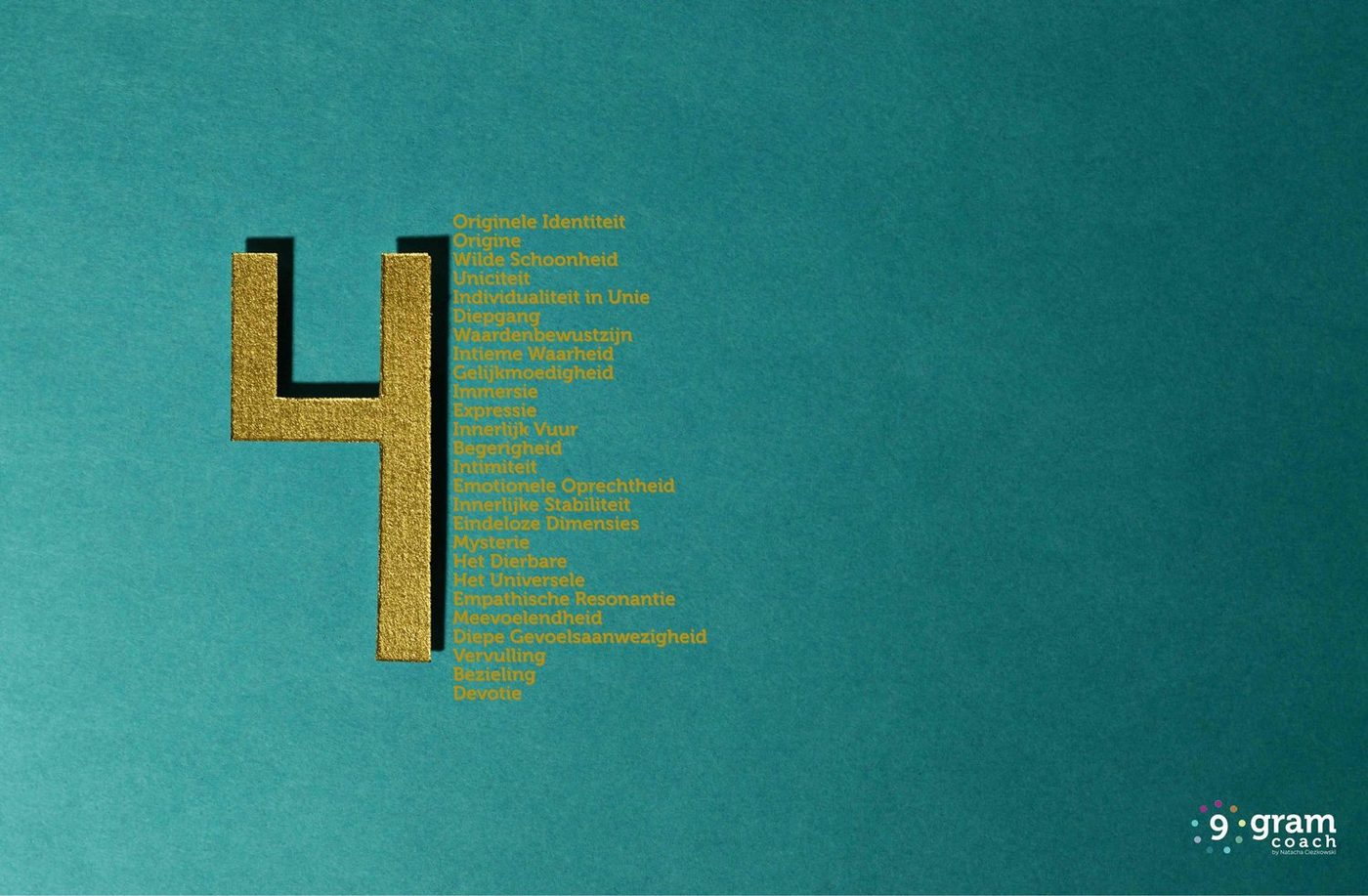
Four is one of the nine natural temperaments present in every human being. Everyone has access to these nine qualities, although our personality structure will emphasise some of them more strongly than others. The Enneagram describes nine fundamental ways in which people experience themselves and the world. Within each point lies an Essence: an innate quality that does not have to be earned, and is a birthright for each one of us.
In earlier essays I explored Point Eight (Vitality), Nine (Unity), One (Purity), Two (Exchange) and Three (Value). In this essay we dive deeper into the essence of Point Four and the way our personality distorts this essence into Enneagram pattern Four. In doing so we once again make the distinction between natural quality (Pure Gold) and personality fixation (Pure Fixation). Enneagram pattern Four - often known as the Intense Creative, Individualist or Romantic - embodies a primal principle of Original Identity and Wild Beauty. I first explore these universal qualities and also principles such as Uniqueness, Depth and Mystery. I then describe how the personality tries to imitate or control them, which leads to survival strategies such as comparison and intensity. What happens when a deeply feeling, meaning-bearing essence is narrowed into identity? In addition, I once again let myself be inspired by nature and the universe, with concrete examples of some universal qualities in their free, unfiltered form. Finally, I offer a reflection on the path from survival to embodiment - how Enneagram Four can move from a forced drive to survive to embodying the true, natural Essence. The essence of emotional authenticity, uniqueness and inner fullness.
Essence – Original Identity as Pure Gold
One of the ways to describe the essential qualities of Point Four is as Sensitivity, a form of Deep Feeling Presence: a rich, nuanced inner landscape in which emotions can move freely (Diamond Approach, A.H. Almaas). This essence brings forth a direct Intimacy with life. Not by amplifying emotions, but by allowing them fully within a wider field of presence. It is a refined form of emotional awareness in which nothing needs to be held on to. Emotions are experienced as dynamic energies that come and go, without becoming a definition of the self. In this state there is no struggle with what is felt, and no identification with it either.
That naturally brings us to the principle of Original Identity, the simple fact that every human expression carries a unique signature, even though it has the same origin or original source. Original identity is awareness of Uniqueness without comparison. In essence, Uniqueness does not need to be proven, emphasised or defended. It is. When this quality flows freely, an experience of individuality arises that does not separate. The self is not experienced as a deviation from the norm, but as a natural variation within the whole. This is what we can call Individuality in Union: unique without being isolated.
A.H. Almaas beautifully describes how Point Four is linked to the 'Holy Idea' (a mental concept we can use as a compass for life) of Holy Origin or Holy Identity. This refers to the insight that nothing essential is missing. Everything we seek - meaning, depth, fulfilment - is already present in the current moment, provided we let life be as it is. The idea that 'something is missing' is seen through here as a mental construction.
Equanimity as original emotional intelligence
The concept of Equanimity is often wrongly interpreted as emotional neutrality or detachment. In reality, equanimity refers to something much more subtle: the ability to carry the full emotional spectrum without disappearing into it. Equanimity is not the absence of feeling, it is the presence of space. Sadness may be there without becoming identity. Joy may light up without being held on to. Longing can be felt without immediately being interpreted as proof of lack. In this state the feeling centre is not overwhelmed, it is intelligent. Emotion is information, not a verdict. It enables us to have Inner Stability - even intense emotions need not disturb our inner balance: anger, sadness, fear, joy and desire (Craving) are part of life and can exist side by side.
Depth, Immersion and Intimate Truth
Point Four naturally carries an exceptional capacity for Depth. Not the depth of analysis, but of dwelling. The capacity to stay with experience, and to be immersed in it (Immersion) without immediately wanting to solve, explain or transcend it. Meaning is experienced in layers without accentuating or romanticising suffering: life may be intense without becoming heavy. Here arises what we can call Intimate Truth: truth that is not conceptual, but felt. Not loud, not spectacular, but precise. This truth does not need to be shared to be real; it is real because it is experienced.
Mystery and Soulfulness
Where Point Four stands in essence, there is also a natural openness to Mystery. Life does not have to be fully understood to be meaningful. I explain it to my coaching clients, among other things, like this: "We could study you for 100 years with 100 experts, and we would find out a lot, a great deal, about you. And at the same time we could never understand you completely: as a human being you remain an immeasurable mystery because you have no solidified identity, you are always changing. The Bianca of now is already not the Bianca of just before this conversation or of yesterday, let alone of 10 years ago." Incidentally, this also means that an evolution takes place in Value Awareness too. Mystery further leaves room for openness to not-knowing, to the enigmatic character of existence. It also means that opposing experiences can exist side by side: beauty and pain, fulfilment and loss, simplicity and depth. This principle also gives access to what is often described as Soulfulness: a quality of presence in which experience is layered. Expression - through art, language, form or silence - does not arise here to prove something. It serves to give form to inner movement, an Inner Fire. Creation and expression arise spontaneously, without any need for recognition or exceptionality.
Some other facets of the Pure Gold of Four
When we are in contact with our essence through Point Four, various qualities come to expression. Through literature, a decade of teachings from Enneagram experts and years of observation in coaching sessions and in nature, I distinguish a rich palette of facets. As a supplement to the previous paragraph, I give a few more here:
Emotional Sincerity – experiencing feelings without dramatising or denying them, with a natural honesty in emotional contact.
Empathic Resonance – a deep capacity for attunement (Compassionate Feeling-with) that meets others without losing oneself.
Origin – a refined sensitivity to the living source from which experience, identity and reality arise moment by moment.
Endless Dimensions – the insight that identity is not a fixed, solidified given but a continuously unfolding process, because nothing in existence is permanent or static.
The Precious – the intrinsic, unconditional and universal worth of every human being (the 'divine' in each of us) that does not have to be earned and shows itself in soulful presence, a Devotion to the human being in all their facets.
Together these facets form the Pure Gold of Point Four: a natural capacity to live intensely, to feel deeply and at the same time to stay grounded in what is.
Mirrors in nature and the universe — how Point Four works without personality
The essence of Point Four is not a psychological construct; it is observable in nature and the universe, which offer us mirrors for what is really at stake here.
Depth without drama: the ocean
At the surface the sea can be wild. Waves crash, storms rage. But whoever descends discovers that the depths remain remarkably stable. The movement above does not disturb the core. This is a perfect illustration of equanimity: emotional movement without structural collapse.
Uniqueness as fact: biological signatures
In nature, uniqueness exists without comparison. Every leaf has a different vein pattern, every zebra a unique field of stripes, every bird a slightly different song. There is no hierarchy in these differences, no better or worse - only variation within coherence.
Intensity without identity: volcanism and star formation
Volcanic processes are intense, destructive and creative all at once. Lava destroys existing forms, and also creates fertile ground. Star formation happens through immense pressure and heat, and yet leads not to chaos but to structure. Intensity here is not identity, but a phase in a larger process.
Mystery without lack: cosmic scale
The universe has empty spaces, dark matter, unexplained phenomena. These 'voids' are not experienced as a lack; they are part of a greater whole. Existence tolerates unknowability without problematising itself.
Original source without differentiation: the universe and the Big Bang
In cosmology the Big Bang is described as the original state of maximum symmetry: an extremely hot, dense initial phase in which no distinct particles, forces or structures yet existed. From this one undifferentiated source arose - through spontaneous symmetry breaking - all later forms: elementary particles, forces, stars, galaxies and ultimately life. Differentiation here is not a deviation from the source, but its natural unfolding. The universe thereby retains a fundamental unity (one origin, one physical lawfulness), while at the same time producing an immeasurable diversity of unique forms. This is uniqueness in union on a cosmic scale: multiplicity without loss of origin.
Animals as a source of inspiration
In all these examples we see that unity in nature does not arise through uniformity, but through attunement between unique entities: uniqueness is not sacrificed to the whole, but is precisely what makes the whole alive, adaptive and intelligent.
Starling murmurations — individual response within collective coherence
Starling flocks (murmurations) form large, dynamic patterns in the sky without central control. Each individual follows only a few local rules: keep distance from nearby neighbours, match speed and adjust direction based on direct perception. Yet a highly coordinated group movement arises that is flexible, adaptive and coherent. Crucially, no single starling gives up its individuality: each bird responds autonomously to its immediate surroundings. 'Union' arises here not through uniformity, but through relational attunement between unique individuals. This is a biological example of how uniqueness and cohesion do not exclude each other, but in fact make each other possible.
Orca pods — individual role, shared identity
Orcas live in stable family groups (pods) with a pronounced social structure. Within a pod, orcas develop pod-specific vocal dialects, hunting techniques and behavioural rituals that are found nowhere else. At the same time each individual retains their own role, temperament and learning path. Young orcas learn through social transmission, not through coercion, and contribute their personal variations to the group's behaviour. The pod functions as a cultural unit, but not at the expense of individual expression. This illustrates uniqueness in union as cultural co-existence: identity is relational, not competitive.
Ant colonies — differentiated functions within one living system
In ant colonies, individuals perform different tasks (scouting, nursing, defence, food transport) without any single ant having an overview of the whole. Each ant acts on local information (scent trails, contact signals), but together a self-organising system arises that responds flexibly to changing conditions. The colony functions as one organism, while each ant makes a specific, non-interchangeable contribution. Uniqueness here lies not in 'personality', but in functional differentiation: difference is not a deviation, but a necessary condition for the whole.
Unique colour patterns in octopuses and cuttlefish — individual expression within a species-specific code
Octopuses and cuttlefish have thousands of chromatophores, iridophores and leucophores in their skin, allowing them to change colour, pattern and texture within fractions of a second. Although the biological mechanisms are species-specific, behavioural studies show that individual animals develop consistent preferences and patterns in how they deploy colour and form - for example under stress, in exploration or in social interaction. Two individuals of the same species therefore do not respond identically to the same context. Uniqueness appears here within a shared physiological system: the species supplies the palette, the individual determines the composition. That makes this a purely biological example of uniqueness in union, without any appeal to a conscious image or identity.
Unique song signatures in whales — individual variation within a collective structure
Humpback whales produce complex song structures that spread through a population as a shared 'song'. Within that collective pattern, however, individual whales show stable micro-variations in timing, pitch and phrasing, which allow experienced researchers to distinguish individual singers. The song is thus at once collectively recognisable and individually unique. This shows that expression is not either-or (individual versus group), but both-and: uniqueness manifests within a shared form, not outside or against that form.
✪ Origin ✪ Uniqueness ✪ Wild Beauty ✪ Depth ✪ Individuality in Union ✪ Value Awareness ✪ Intimate Truth ✪ Equanimity ✪ Immersion ✪ Expression ✪ Inner Fire ✪ Craving ✪ Intimacy ✪ Emotional Sincerity ✪ Inner Stability ✪ Endless Dimensions ✪ Mystery ✪ The Precious ✪ The Universal ✪ Empathic Resonance ✪ Compassionate Feeling-with ✪ Deep Feeling Presence ✪ Fulfilment ✪ Soulfulness ✪ Devotion ✪
Individual 'voice prints' in dolphins — unique acoustic identity within social cohesion
Bottlenose dolphins produce so-called signature whistles: specific whistle patterns that are unique to each individual and function as an acoustic identification, comparable to a name. These whistles are stable throughout life and are recognised by other dolphins and used to call a specific individual, even when it is not visible. At the same time the communication remains fully embedded in a shared acoustic system: all dolphins use the same biological mechanism and the same sound categories. Uniqueness here appears not as a deviation, but as differentiated expression within one collective language. The social unity of the group is in fact strengthened because each individual is audibly distinguishable. This is an exceptionally clear example of Uniqueness in Union: identity arises relationally, not through separation but through recognisability within connection.
Unique coat patterns in leopards — variation within a shared blueprint
Leopards belong to one species with a clearly recognisable coat motif (rosettes), but no two leopards have the same pattern. This individual variation arises from non-linear developmental processes during embryonic growth, in which genetic rules and local interactions between pigment cells together produce a unique end result. The species thus supplies a common developmental logic, while the individual embodies an unrepeatable configuration. Uniqueness here is not a deviation from the norm, but the inevitable consequence of a shared biological order that leaves room for differentiation. This is uniqueness in union in its most literal form: one species, one genetic framework, infinite variation.
The peacock's tail — individual expression within a collective aesthetic pattern
The peacock's tail is a classic example of sexual selection: a species-specific form shared by all male peacocks, yet varying strongly in detail from individual to individual. Number of eyespots, symmetry, colour intensity and movement dynamics differ per individual, while the whole remains instantly recognisable as a 'peacock's tail'. The tail functions not merely as ornament, but as a communicative field in which individual quality becomes visible within a shared principle of form. There is no conflict between individual expression and collective recognisability: precisely because the form is shared, uniqueness can acquire meaning. Here too, union arises not through uniformity, but through a common framework in which differences become legible.
From Essence to personality — when depth narrows into identity
Enneagram Four is often described in terms of melancholy, longing and intensity. We saw earlier how the natural Point Four in each of us is in origin not a temperament of lack, but of fullness. Not a structure that suffers, but a feeling quality that is exceptionally refined. Not an archetype of drama, but of emotional truth.
As with every Enneagram point, personality arises when the essence cannot flow freely. With Point Four this happens through a subtle but far-reaching shift: experience becomes identity and I compare my experience with that of others.
The Equanimity I described earlier then becomes the passion of Envy or Jealousy: the constant comparing with others and the feeling that life has given them something you lack. Equanimity returns when comparison falls away and makes room for a balanced view of reality - both inner and outer.
From feeling to clinging
When emotional depth is not carried by equanimity, over-identification arises. Feelings become heavier than they are. Sadness becomes "who I am". Longing becomes proof that something is missing. The personality thus tries to hold on to what in essence should move freely.
The illusion of lack and comparison
The central distortion of Enneagram Four is the conviction that others possess something you lack - a form of completeness, lightness or ease. This comparison can lead to feelings of inferiority ("they have it, I don't") or superiority ("I feel more deeply, they don't"), but both start from the same misconception: that worth is scarce.
Intensity as a substitute for presence
What was originally depth becomes intensity. Emotion is amplified, thickened, sometimes even cultivated, because intensity gives the feeling of being alive. But intensity without space does not lead to fulfilment; it leads to exhaustion and isolation.
Melancholy and self-image
When pain and longing are visited repeatedly, they can become part of the self-image. Melancholy then becomes not a passing mood but an identity. This shuts off spontaneous joy, because joy is experienced as superficial or disloyal to the 'real' experience. 'Being different' then becomes a personal project.
Pure Fixation — imitating essence
What is crucial here: the personality according to Enneagram pattern Four wants the same as the essence. It wants authenticity, meaning, depth, uniqueness. But it seeks them by detours.
It tries to be unique by setting itself apart.
It tries to preserve depth by holding on to pain.
It tries to guarantee authenticity through intensity.
And precisely because of that, the opposite of what is sought arises: alienation, stagnation and emotional heaviness.
Return — the movement towards equanimity
The way back for Enneagram pattern Four is not an emotional correction, but a relational shift in relation to experience. Not feeling less, but feeling more spaciously. Not ceasing to long, but uncoupling longing from lack. Not giving up expression, but freeing it from the need to prove. When emotions are allowed to move again without becoming identity, equanimity returns. Then it becomes clear that this moment - however raw or simple - is enough to be true. Uniqueness reappears as natural presence. Depth becomes bearable. Expression becomes playful. And connection arises precisely where comparison falls away.
Original identity as a kaleidoscopic phenomenon — identity as process, not as object
In my experiential programme Pure Gold I use the image of the kaleidoscope to approach Original Identity, and this image is phenomenologically remarkably precise. A kaleidoscope consists of a fixed configuration of mirrors and elements, but the pattern that appears is inherently relational and temporary: it arises anew each time as a function of minimal shifts in position, light and movement. The image has coherence, but not stability; form, but no fixed end point. In a similar way Original Identity does not manifest as a delimited 'something' that can be pinned down. It is a dynamic phenomenon that continuously changes configuration. Every experience, every perception, every nuance in presence rearranges the whole. Every nanosecond is different, not because we are 'fickle', but because life itself is dynamic. Identity here is not a substance, but a process of appearing.
From a phenomenological perspective this means that identity cannot be understood as an object of knowledge - something one can define, possess or prove. It is a living structure of experience that unfolds moment by moment. Attempts to fix identity in one image, one story or one self-definition necessarily imply a reduction: a stilling of movement. Precisely there, personality arises. The personality structure selects one snapshot from the kaleidoscopic field - often an intense, meaningful or painful facet - and elevates it to identity. Enneagram Four is particularly vulnerable here, because the richness of the feeling field is easily confused with 'who I am'. The kaleidoscope image makes visible that no single pattern is the truth; each pattern shows something, but none contains the whole. Original Identity therefore asks for tolerance of continuous change instead of definition. That capacity - to allow mobility without losing oneself - is equanimity at the level of identity.
Closing reflection
In biological expression (colour, sound) as well as in cosmic origin history, we see the same principle return: uniqueness does not appear despite a shared origin, but thanks to it. Differentiation is not a break with the source, it is a natural expression. Point Four reminds us of something that is easily lost in a performance-driven culture: that meaning does not have to be created, but discovered. That depth does not require suffering. That uniqueness is not separation. When the personality relaxes, the Pure Gold of Point Four appears of its own accord: Original Identity, Emotional Sincerity, Mystery, Soulfulness and Equanimity. Not as an ideal. As experience.
And perhaps that is the deepest truth of Point Four: that what we seek most is already present - precisely where we stop seeking.
Sources
Almaas, A. H. (1996). The point of existence: Transformations of narcissism in self-realization. Shambhala Publications.
Almaas, A. H. (2002). Facets of unity: The Enneagram of holy ideas. Shambhala Publications.
Bourgeault, C. (2016). The heart of centering prayer. Shambhala Publications.
Capra, F., & Luisi, P. L. (2014). The systems view of life: A unifying vision. Cambridge University Press.
Cavagna, A., & Giardina, I. (2014). Bird flocks as condensed matter. Annual Review of Condensed Matter Physics, 5, 183–207.
Damasio, A. (1999). The feeling of what happens: Body and emotion in the making of consciousness. Harcourt Brace.
Daniels, D. N., & Price, V. A. (2010). The essential Enneagram: The definitive personality test and self-discovery guide. HarperOne.
Darwin, C. (1871). The descent of man, and selection in relation to sex. John Murray.
Diamond Approach. (n.d.). Enneagram type four: Holy origin, envy, and equanimity.
Enneagram Institute. (n.d.). Type Four — The individualist.
Enneagram Monthly. (2024). Fours: Navigating the loop of comparison and identity.
ESA. (2022). Cosmic origins and the early universe.
Ford, J. K. B. (1991). Vocal traditions among resident killer whales (Orcinus orca) in coastal waters of British Columbia. Canadian Journal of Zoology, 69(6), 1454–1483.
Garland, E. C., et al. (2011). Cultural transmission of humpback whale song. Proceedings of the Royal Society B, 278(1724), 1–8.
Goldstein, J. (2002). One dharma: The emerging western Buddhism. HarperCollins.
Goodwin, Brian. (1994). How the leopard changed its spots: The evolution of complexity. Princeton University Press.
Hanlon, R. T., & Messenger, J. B. (2018). Cephalopod behaviour (2nd ed.). Cambridge University Press.
Hölldobler, B., & Wilson, E. O. (2009). The superorganism: The beauty, elegance, and strangeness of insect societies. W. W. Norton & Company.
Integrative Enneagram Solutions. (n.d.). Nine holy ideas and personality structures.
Janik, V. M., & Slater, P. J. B. (1998). Context-specific use suggests that bottlenose dolphin signature whistles are cohesion calls. Animal Behaviour, 56(4), 829–838.
Janik, V. M., Sayigh, L. S., & Wells, R. S. (2006). Signature whistle shape conveys identity information to bottlenose dolphins. Proceedings of the National Academy of Sciences, 103(21), 8293–8297.
Kabat-Zinn, J. (1994). Wherever you go, there you are. Hyperion.
Maitri, S. (2005). The spiritual dimension of the Enneagram: Nine faces of the soul. Tarcher/Penguin.
Merleau-Ponty, M. (1962). Phenomenology of perception (C. Smith, Trans.). Routledge. (Original work published 1945)
Murray, J. D. (2003). Mathematical biology II: Spatial models and biomedical applications (3rd ed.). Springer.
Naranjo, C. (1994). Character and neurosis: An integrative view. Gateways Books.
NASA. (2023). The Big Bang.
National Geographic Society. (2024). Why octopuses change color and shape.
National Marine Mammal Foundation. (n.d.). Dolphin signature whistles and individual identity.
NOAA Fisheries (n.d.). Killer whale social structure and culture.
Payne, R. S., & McVay, S. (1971). Songs of humpback whales. Science, 173(3997), 585–597.
Petrie, M., Halliday, T., & Sanders, C. (1991). Peahens prefer peacocks with elaborate trains. Animal Behaviour, 41(2), 323–331.
Prigogine, I., & Stengers, I. (1984). Order out of chaos: Man’s new dialogue with nature. Bantam Books.
Riso, D. R., & Hudson, R. (1999). The wisdom of the Enneagram. Bantam Books.
Royal Society (2010). Starling flock networks and collective behaviour.
Schore, A. N. (2003). Affect dysregulation and disorders of the self. W. W. Norton & Company.
Siegel, D. J. (2012). The developing mind: How relationships and the brain interact to shape who we are (2nd ed.). Guilford Press.
Weinberg, S. (1977). The first three minutes: A modern view of the origin of the universe. Basic Books.
Wilson, E. O. (2012). The social conquest of Earth. Liveright.