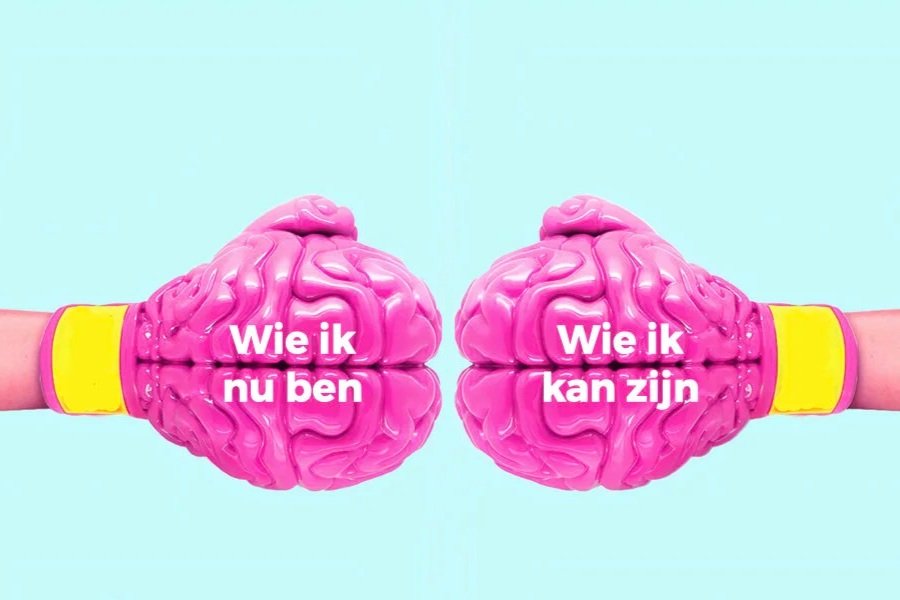


Why is it so hard for a man to show his emotions, by crying for example? Then I go back to our childhood, when it wasn't okay to cry on the playground … or at any rate we fought it, because ‘boys don't cry’.
According to Darwin, crying men weren't valued anywhere in the world. Could cultural differences be at play? Several studies show that in wealthy countries crying is perfectly normal, probably because of the greater freedom people enjoy there. The time when most crying happens is between 6 and 10 in the evening. Cosy at home and perhaps alone.
First and foremost, crying is a ‘cry for help’, and I'm starting to think that's where the shoe pinches, because of course that too is not done for the über-man. We don't ask for help, let alone bawl about it.
And what about the question of whether men really do cry less than women and so deliberately try to limit showing deep emotions? What do we actually know about this?
In the Netherlands they have an expert on this topic, Ad Vingerhoets, clinical psychologist at Utrecht University and author of the book ‘Why Only Humans Weep: Unravelling the Mysteries of Tears’. His research allows us to list a number of findings:
Men apparently have larger tear ducts, so when tears well up, one is less likely to roll down the cheek
Testosterone does its bit too: prostate cancer patients treated with hormone blockers become emotional more often
A woman's tear contains a higher level of prolactin (up to 60% more), which is produced by the pituitary gland - it plays a role in our emotions
Until puberty this is said to be the same for boys and girls. It is in any case a way of explaining the difference in crying between women and men biologically … it's just a thing!
Fine, so when it comes to crying, it's a ‘simple’ biologically explicable difference. But of course it doesn't always have to come to tears, so what about expressing your feelings verbally as a man?
Did you know that research has shown a woman spouts 13,000 more words a day than a man ... That's 50 pages more words and possible expressions of emotion … per day! So the average man unconsciously knows that when it comes to emotions he's on thin ice. And perhaps that's why he'd rather not engage in that conversation.
250,000 years of evolution hasn't really helped us either. Man simply stood guard to protect the group from the many whims of nature. He was the one who could make the difference between life and death. It all seems a lot easier from our comfy armchairs now, but it's still in our genes, even after such a long time. Even now ‘the group’ benefits from a man who can keep a cool head and so make progress for everyone. We need a leader with focus; distraction is not wanted, still not.
A man does have a way of expressing his feelings, mind you. Or of responding to yours … absolutely. Just as he was raised from an early age, he simply wants to do something to solve ‘the problem’. Talking not so much, no, but getting into action and off we go. Even if that makes no sense at all to you as a partner, he wants to be able to do something about it.
Does this mean we men know nothing about dealing with our feelings? In this twenty-first century, isn't it normal for men to be a bit more vulnerable? The answer is an unequivocal ‘yes’. What used to be associated with the word vulnerability was ‘weakness’, and our society didn't allow that for men. Nobody is interested in a ‘weak’ person.

Fortunately, we live today in a society that - not yet completely - is more open to showing and putting words to your male emotions. You'll find, as a man (and a woman), that being more open to this will bear fruit. It allows you to come closer to yourself and so also closer to your partner, children or family.
The man who can do this is the man I'd like to be. Away with the yoke of old, done with being tough when things go against you; crying (even though it doesn't come naturally to us) is allowed!
It doesn't get in the way of my role as a bloke at all, quite the opposite.
Steve: “I'm an Enneagram type 8 (SX) and it took quite a lot of time and energy (and still does) to reach this conclusion myself. As a professional coach I'm well placed to work on this with other men. Mail: steve@youbility.coach